Give & Receive Energy

Summary
Concern about glyphosate in wheat and additives in food motivates people to grow their own food and choose organic foods. Choices such as being vegetarian or vegan, in turn, need to make sense for each person without becoming labels. At CEC courses, paying attention to how people are welcomed, the food, and social interaction is part of setting an example, as is doing good work even when no one is watching. Keeping the group going requires awareness and organization, and personal evolution calls for effort to work through emotional difficulties and learn to accept being told no. Translation needs to preserve meaning beyond the words. Gestures and gifts make it possible to form bonds even without a shared language.
Source transcript
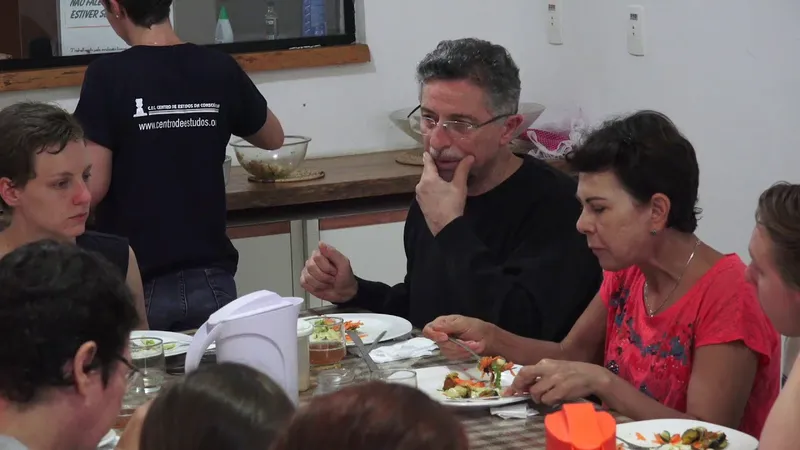
I put a question to the table and asked for sincerity: what harm does gluten do? A listener explained the difference between celiac disease and intolerance — with celiac disease there are skin complications and strong reactions; with intolerance, bloating and intestinal discomfort. Gluten, however, is a staple food of humanity, and the problem is not in it: wheat was hybridized to yield more and, at harvest, receives Roundup, so glyphosate rises into the grain. That is why one can eat pasta in Italy without feeling ill, and not here. The allergy is not to gluten, it is to what is put into the food and to the way we are treating wheat. But the amount of gluten is much higher. A listener said he had researched the subject because he is producing a food with imported wheat: in Europe the permitted limits are strictly observed, in Brazil the level is above what is recommended, and the difference shows in the finished pasta.
I then asked whether there is any healthy food in Brazil. They answered: what we plant at St. Damian, what the small farmer grows without pesticides, the organic — the food the insects also eat. We talked about potato chips, about the potatoes that come in a little box, about carton milk. I asked whether they knew the composition of carton milk; someone guessed a preservative, sodium. I said it contains hydrogen peroxide and caustic soda, and that one day I will pass on the list of the things we eat — and then everyone will find a problem with eating. Even the air we breathe is already terrible, though Itatiba was considered the place with the best oxygen on the planet—for now. That is why it is good to have our own planting: we do not really know what we are eating.
I asked whether everyone there was vegetarian. A listener corrected herself: she is not vegetarian but ovo-lacto-vegetarian, because a vegetarian is someone who eats only vegetables. They explained that a vegan, besides eating nothing of animal origin, also uses no leather, honey, or silk. A listener remarked that this is where extremism begins: nature offers so much, and a person may see the bee as a slave without its being one. We keep seizing truths and wanting to become a label, to have a flag. The question that matters is another one — do we make a choice in order to belong to a group, or because it makes sense within us?
They told us about a vegetarian restaurant in Ribeirão, from which they brought back ideas. The little cups in which tea was served were cut glass guaraná bottles; there was a beautiful piece of furniture to hold the coffee and the cups. Afterwards they went for coffee at a place with an old bicycle, one of those without the middle bar, and a parasol made entirely of crochet. They also remembered the Pousada Damaju, in Florianópolis, where they placed round candles inside cream-cheese cups hung from a transparent thread — they seemed to float in the air, and at night they were lit. And the young man who brought the spoon inside a little chintz bag. Simple things, with a delicacy we do not always make use of.
The conversation turned to the way we present things in the courses. Whoever arrives takes in the whole experience: the welcome, the table, the candles, the lunch, the relationships. Many people have never eaten a fully vegetarian meal before coming here. One person told me she did not want to go back to her life; I answered that we can make our life better, all of us. What I always say here at CEC is that we have to do everything so as to be an example. Anyone who is a bad model for the people around them is not helping, but hindering. Setting an example only when someone is watching has nothing to do with self-growth or self-evolution. If we set out to do a work here, it has to be done well — and all the time, not only when there is a course.
I think about the day when I am no longer here: someone will have to carry this on. It is easier to do nothing. To keep a group united you need someone with awareness, organized, not held back by emotional difficulties — and the person has to make an effort to resolve their own questions. No one becomes a spiritualist and turns into a saint; it takes a great deal of work on what one is. And everyone wants to receive. It is also necessary to learn to receive a no, because when all you have is work to do, you will be receiving a no from life.
We talked about the expression "sucesso total", which has become a trademark, and about how to translate it: in Spanish, éxito, totalmente exitoso. In English we have not yet found an expression that carries that energy — it is not a matter of translating literally. At the previous day's translation working party, every hour someone asked how to translate this or that; there are things in Portuguese that are difficult. When we translated "The Meaning of Life" into Italian, the title became "Il senso della vita", but it is not the same thing: for us, the meaning of life carries something else. The film is nearly ready, and the first approval is the filmmaker's.
I told them that until recently I thought olives were born in the jar — everything already came in the jar. Then I went to Italy and saw people harvesting them. Here in the orchard, during a visit for the astral projection course, Paula called a tree a Ceylon olive, but it was only a siriguela, and someone in the group saved the situation. Vargas went to buy olive trees for us and brought back enormous ones, with very large olives; when we looked closely, they were ornamental — and it was not just one tree, it was a whole lot of them. They cannot be eaten, but they are beautiful and even serve for a Christmas effect.
We talked about being able to communicate without the language. At MediaWorld in Italy, I was looking at a tripod when Mário, an Italian man, came up talking very fast, hugged me and spent more than half an hour in conversation with me; I answered only with gestures, and at the end he said goodbye with a kiss on the cheek. It was like the first time I met Jorge: it seemed he had known me for years. Vargas harvested olives singing with the Italians without understanding a thing, and got along with Guilherme by bringing him food as a gift — he bought a chicken so that Guilherme would not eat his daughter's rabbit. He would arrive at Alberto's house with a piece of cheese and a loaf of bread, ask for a coffee, and never talked so much. If you cannot speak at all, you can say everything.
At the end, since it was already November, the conversation turned to the Christmas tree. I told them that once I made a tree out of branches: I took from the grounds a trunk full of branches, hung it from the ceiling with a thick nylon line and put Christmas baubles on it. If a breeze came, it would move. It was lit as well, and it turned out very beautiful.
Questions raised by this material
- Why set a good example even when no one is watching?
- Why should our choices go beyond labels?
- How can we show care for people in the little details?
- Why does being a spiritualist require us to work on our own emotional difficulties?
- How can we communicate without speaking the same language?
Keywords
How to cite
Esagüi, M. (2019, June 9). Chat at St. Damian [Video]. Center for Consciousness Studies. https://centrodeestudos.org/en/library/chat-at-st-damian-2/