Give & Receive Energy

Summary
Childhood experiences influence relationships: affection helps organize the ego, while deprivation and violence heighten defenses, and excessive pampering can lead to dependency. Observing and facing your own difficulties, without justifying negative behaviors or getting lost in fantasies and unrealistic expectations, helps resolve external issues. This effort involves recognizing that emotional conflicts can become irreconcilable and accepting family members' traits to become your own person. Making a list of fears and difficulties is a way to observe what is troubling you internally.
Source transcript
Let us discuss the difficulties in relationships—with ourselves and with the people around us—addressing topics that are part of our life trajectory. A person with better living conditions, whose parents are able to provide food, clothing, education, and affection, tends to have more inner resources for organizing their ego. In contrast, someone who faces deprivation—such as a lack of enough food, or parents who raise their children with violence instead of dialogue—will have more difficulties. The level of defense we need to create in order to survive directly affects how easily we relate to others.
People who constantly need to defend themselves tend to be less open to the world and less happy. On the other hand, someone who is very pampered, even in a favorable family environment, may not learn to take care of themselves, becoming dependent on others to satisfy their needs. That person may become irritated when their expectations are not met, which is not healthy. Life can teach them the need for change if they meet assertive people.
In the first years of life—from 0 to 7 years old and from 7 to 14 years old—we are more receptive to information that influences our future relationships. Parents who are affectionate and who relate well teach this type of interaction, making emotional management in challenging situations easier. We can identify our difficulties by observing our daily behavior. How do we relate to ourselves? Do we have inner conflicts, fears, or somatizations? Do we face difficulties in meeting new people or in family situations? Do we have difficulties or guilt related to sexual behavior? Is competitiveness seen as positive? It is important to analyze these questions internally, because the best relationship begins inside ourselves, without constant inner dialogues and groundless worries.
Some people feel persecuted, controlled, or subjugated—a reflection of processes that began in childhood. Being happy and relaxed is essential. How do we sleep? These questions reflect who we are and influence our external relationships. A sincere analysis of our behaviors is fundamental. Anger, aggressiveness, revenge, and resentment are not normal. We often justify negative behaviors with incoherent excuses, such as "everyone does this." We need to face ourselves and organize ourselves internally in order to follow a clearer and more coherent path. Otherwise, we will live in a negative state full of fears, without reaching our goals. We only get somewhere when we know the way, not when we know where we want to arrive.
There is no final destination; our story is a continuous path. This path is all we need to understand, because it is infinite. No matter what you choose to do—whether studying engineering or anything else—it is part of your path. Being an engineer, for example, is not the end of the story. We are not something fixed; we are always in transformation.
It is important to observe and reflect on a few aspects. Do you feel a distancing from reality? This happens when your life goes on beside you while you live in a parallel world, full of fantasies and unrealistic expectations. In this way, your life moves away from reality. In addition, it is crucial to analyze how you deal with your affective conflicts. Do you have difficulties in your relationships, whether with male or female partners? These conflicts can be overcome up to a certain point; beyond that, they become irreconcilable and a torment for our life.
Reflect also on your family relationships. Do you get along with your family? Are you able to accept your father, your mother, your siblings? Often, our parents' characteristics can be difficult to accept sincerely. We may say that we like them, but in practice, dealing with certain attitudes, ways of dressing, or ways of speaking can be challenging. Learning to deal with these issues is essential, because when we do not manage to, we get emotionally involved in a negative way. That prevents us from individualizing ourselves, which is fundamental to happiness.
I suggest that you make a list of the things that bother you internally—such as fears and difficulties—for example, shyness when presenting an assignment. It is important to have focused attention when reading a book, because that helps you organize your life more efficiently. When, through effort, we manage to organize our ego and overcome inner difficulties, we also resolve external issues, since everything begins inside us.
Questions raised by this material
- How does childhood influence relationships in adulthood?
- How can you identify emotional difficulties that affect relationships?
- How does your relationship with yourself influence your relationships with others?
- How does justifying negative behaviors make change more difficult?
- How does accepting your parents help with individuation?
Keywords
How to cite
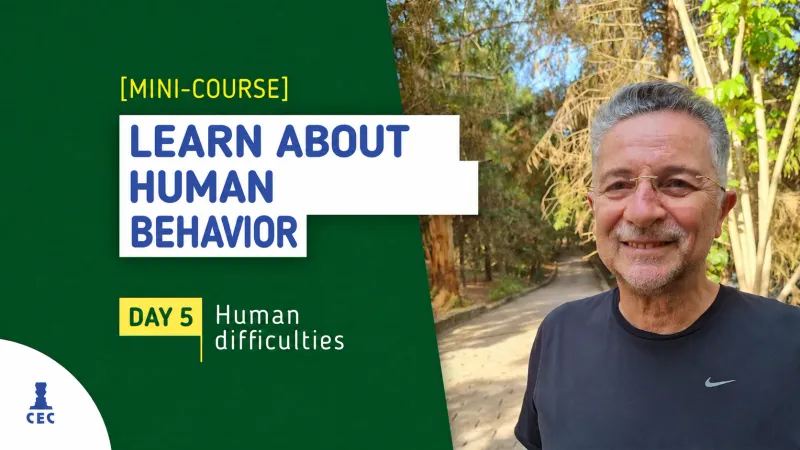
Esagüi, M. (2013, May 29). Mini-course Learn about Human Behavior, Day 5 - Human Difficulties [Video]. Center for Consciousness Studies. https://centrodeestudos.org/en/library/mini-course-learn-about-human-behavior-day-5-human-difficulties/