Give & Receive Energy

Summary
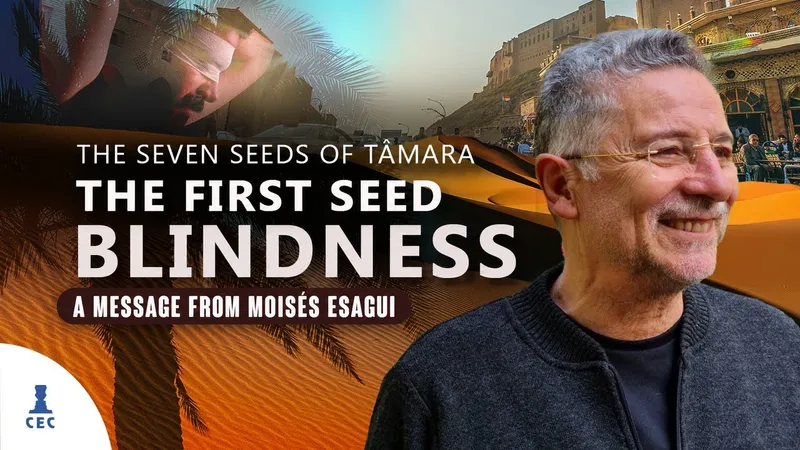
A blind man who can perceive details and intentions realizes, through Eliphas's questions, that he previously had little insight into himself, which was reflected in distrust, anger, and aggressiveness. The first of these questions is: “How can a blind person see colors?” Seeing life requires a journey and inner time to become aware of ourselves, something good physical eyesight does not guarantee. Life is within us, and relationships are an opportunity to understand it.
Source transcript
The book "The Seven Date Seeds" has a few peculiarities. One of them is that it was written at different times. I remember going to Uberaba to do the TV program in person; it was more than a thousand kilometers round trip. During those travels, because my energy was always upbeat, everything was a lot of fun for me. Work is something enjoyable.
I am going to read the first date seed, entitled "Blindness." In it, there is a scene in which a blind man is sitting with his hand extended, and another man approaches. Sitting on the ground with his right hand open, waiting for help, the blind man senses someone approaching. The man places a loaf of bread in his hand and, holding some money in the other, says, "May God help you find the light." The blind man replies, "Your clothing is white, you are wearing Moroccan sandals, and you are carrying a sandalwood fan in your left hand because you are left-handed." Surprised, the man accuses him: "You are not blind; you are a charlatan, a liar. Give back the bread and the money." The blind man replies, "I will not miss this bread and this money; you may take them. But I would like you to hear a story."
The man asks, "Why would I listen to a story told by a liar?" The blind man explains, "I am blind only physically, but I have a kind of sight that few people have, and that is why I want to tell you a story." The man threatens to assault him to test his blindness, but realizes that the blind man does not defend himself and confirms that he was telling the truth. Someone nearby shakes their head and rebukes the man's gesture. The blind man says, "That gesture did not frighten me, because I knew your intentions." The man asks, "Did you see that I was going to assault you?" The blind man replies, "I saw that you wanted to test whether I am truly blind, but I see what you do not see. That is why it would be good for you to hear what I have to say." Confused, the man takes a bench beside the blind man and asks, "Why do you not use the bench to sit down?" The blind man replies, "It is for the people who want to hear me. Please, sit down."
The man sits down somewhat awkwardly and waits for the blind man to begin speaking. The blind man reveals, "I was not always blind. There was a time when I was blinder than I am now. My physical sight was good, but my perception of life was so poor that I could barely see myself. When we cannot see ourselves, we behave as you do: with distrust, anger, and aggressiveness. I was like that until an event radically changed my life. I met a man named Eliphas, who posed three questions to me but said that I would not be able to answer any of them. I found that outrageous and said that he could pose them, believing that I would know something about the subject."
Eliphas said, "I will ask you the first question, and if you do not know how to answer, I will consider whether I should ask the other two. On second thought, I will ask all the questions, and you can think about them and then tell me whether you want to answer them." The questions were asked one after another, and little by little I realized how blind I was. Now you must want to know which questions Eliphas asked, but I will reveal only the first, because I know it will remain unanswered: "How can a blind person see colors?" This is something very interesting in our lives. Even with perfect physical sight, we cannot see life.
We do not understand it, and physical death, for most of us, even with intensive training to believe in spirituality, is an unknown. Seeing life requires a path and inner time to perceive every detail of ourselves. Life is not outside; it is within us. Every relationship we can establish is a wonderful gift from the universe, and it is important to make the most of this moment. It is a glorious moment, even amid the many lives we have already had here, which have trained and conditioned us more than they have brought us into the light. We have a great chance to understand this entire story.
Questions raised by this material
- Why does having good eyesight not mean you understand life?
- How does a lack of self-knowledge contribute to aggression?
Keywords
How to cite
Esagüi, M. (2018, September 22). The Seven Date Seeds - The first seed - Blindness [Video]. Center for Consciousness Studies. https://centrodeestudos.org/en/library/the-seven-date-seeds-the-first-seed-blindness/