Give & Receive Energy

Summary
Knowing our own energies requires honestly observing our thoughts, emotions, and behavior, because habits and conditioning can conceal contradictions and energy loss. Noticing how we feel when alone and recognizing anger in minor frustrations helps with this self-observation. We can know our energies only when we do not mix them with those of others, maintaining balance in response to the “yes” and “no” we receive and taking a stand against speaking ill of others. Since our emanations affect people and environments, this ongoing work allows us to recognize what needs to change and take responsibility for what we produce.
Source transcript
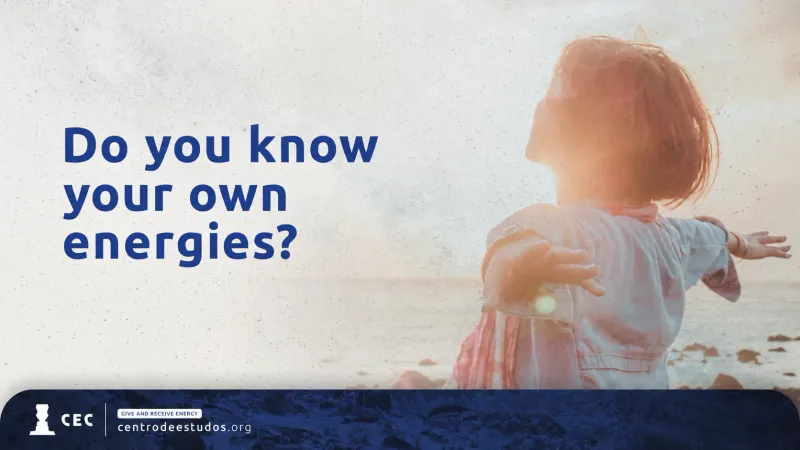
Do you know your own energies? This question can provoke profound reflection. Our energy is an essential part of who we are. Even for those who seek self-knowledge and spirituality, this question can be challenging. When we think about who we are, we usually mention our name, profession, or titles, but we rarely talk about our energetic productions. If we could see our own energies, we would have a more faithful and authentic answer about our essence. This reflection leads us to consider our existence in an integrated way: physical, energetic, emotional, and spiritual.
In daily life, we tend to separate these dimensions, but everything in the universe is energy. Energy exchanges are present in every relationship and composition. Understanding this gives us a broader view of ourselves and the world around us. When we ask, "Who are you?" we generally answer based on what we do, such as our profession or hobbies. However, what we truly are is the energy that permeates our actions and the way we perform them. We often lack clarity about this because our behavior is influenced by factors we do not perceive. Even when we believe that we act according to a particular morality, we may unknowingly behave in contradictory ways because of conditioning and ingrained habits.
When someone does not do what you expect, you comment to a colleague, "Did you see how so-and-so is this way, that way, and the other?" We do not realize that all these movements compose our energy. It is not only a matter of your profession, but of clearly seeing your behaviors in order to understand your energies. It is fundamental to emerge from this shadow, this dullness that constitutes us. We are born into families with energy patterns similar to our own, even if we cannot consciously see them. This does not mean that we will continue this way, but it gives us a better sense of who we are and the conditions needed to leave these situations.
There are things we do in life that seem normal but cause suffering without our realizing it. We become so accustomed to them that we do not notice how we lose energy or how poorly we feel after a meeting in which we do nothing evolutionary. There is no growth in discussion circles where people speak badly of others. We reproduce behaviors without perceiving the consequences, wasting the opportunity for growth in this incarnation. Over time, life leads us to perceive that something is wrong, bringing discomfort. By living with different people, we realize that there are other ways to live.
Self-perception is crucial to making use of the opportunity for evolution that life offers us. Seeking knowledge about our behavior helps identify what is unhealthy and needs to change. We create behavioral "garments" for living in society, but we need to be honest with ourselves. Drawing closer to who we truly are requires setting aside these social "garments." We should not be different in each environment; we should be authentic everywhere.
When we speak about anger, people recognize it only when it is exacerbated, as in a shout. But anger has many variations, such as minor frustrations. When we ask whether someone feels anger, most say they feel little anger or almost never feel it because of ignorance or lack of knowledge. We need to open ourselves to understanding things as they are, because the search for self-knowledge is continuous. Social interaction can mask our emotions, mixing them with expectations of how we want to be seen. We need to analyze how we feel when we are alone, without distractions, in order to understand our emotions.
Technology distances us from who we truly are, concealing emotions such as anger and frustration. Our emotional system developed for survival, generating reactions and emotions. Most consciousnesses operate in dense emotional patterns through the lower chakras. Being honest about this is crucial so that we do not lose the opportunity to grow. Self-observation is simple and does not require advanced practices. During the Daily Assistential Task (TAD), we can perceive our thoughts and energies and direct them toward more advanced consciousnesses.
Keeping a small notebook in which to record emotions and thoughts is useful. Minor feelings of anger, such as irritation at not being greeted, are important for self-observation. Everything is energy, and what we feel affects the environment and the people around us. We must be responsible for our energetic emanations. The work is profound and requires continuous effort to improve as a consciousness and emit better energies.
Emotional involvement with others is a key point for evaluating our condition. As Moisés teaches at the CEC, neither the "yes" nor the "no" we receive should destabilize us. We should maintain our balance regardless of what others say or do. Evaluating how we react to "yes" and "no" reveals a great deal about us. Knowing our energies is possible only when we do not mix them with those of others. Emotional involvement is also energetic, and we need to define our energies so that we are not affected by what happens to other people.
When someone tells us something negative, we need to know how to take an energetic position without allowing ourselves to become contaminated. When we define ourselves, our energies remain with us and other people's energies remain with them. This enables us to perceive what is ours and what belongs to the other person, promoting our growth. This clarity is valuable and should not be viewed as something distant. We can learn from examples of assertiveness and seek healthier relationships.
Life offers us daily challenges that reveal who we are and give us opportunities for resolution. We should seek to learn from these challenges by living with people who pursue growth and healthy relationships. We sense when something is positive and directs us toward a greater construction. We should emotionally distance ourselves from situations we no longer want for ourselves, such as malicious talk. When we take a position, we may be seen as cold, but we should be aware that we are working on our own behalf.
Expressing gratitude sincerely is important. We do not need to throw a party to show gratitude; a simple, sincere "thank you very much" is enough. We should seek our sincerity and convey it without worrying about always being right. As Moisés teaches, learning comes through relationships, and the closer our relationship with ourselves is, the better we will see others. The challenge is to learn to deal with everyone's emotional intricacies, establishing increasingly better relationships. The ideal is to know our own energies and see clearly what we produce. Until we reach this ideal, we should practice and pay attention to our vibrations and energies. This will enable us to benefit from this perception.
Questions raised by this material
- How does self-observation help you understand your own energies?
- How does speaking ill of others affect our energies?
- How can we recognize anger in minor frustrations?
- How can I distinguish my own energies from other people's energies?
Keywords
How to cite
Cabral, P., & Rodrigues, M. (2023, May 23). Do you know your own energies? [Video]. Center for Consciousness Studies. https://centrodeestudos.org/en/library/do-you-know-your-own-energies/