Give & Receive Energy

Summary
A fast pace contributes to anxiety; the gradual development of self-knowledge and the evolution of consciousness help maintain calm and steadiness in the face of stress. The practices begin with observing the body and breathing, followed by self-massage based on lymphatic drainage, working on the neck, face, arms, and hands without causing pain. During meditation, attention moves from head to toe: you breathe in deeply, hold your breath for three seconds, and breathe out to release tension. Self-assessment allows you to notice changes in thoughts, emotions, and energy, which are interconnected. At the end, energies are exteriorized through the palms of the hands to spiritual helpers for assistance.
Source transcript
Stress is a universal experience that may manifest in acute or chronic form. Anxiety, hypertension, depression, and panic are disorders directly related to stress. Our evolution as consciousnesses incarnated on Earth forms part of understanding these issues.
Perceiving who we are and what is happening internally is a lengthy process. Many of us live at an accelerated pace that we have considered normal since childhood. However, this pace is not natural. We have made time more important than our own life. Since childhood, we follow rules and schedules, with little time for playful activities. Technology also intrudes on children's lives. As adults, we maintain a frantic pace, often without noticing it. This pace distances us from emotional difficulties, but it also prevents us from connecting with ourselves.
We create rules and goals that force us to live at high speed, with no time for ourselves. This generates an anxious process: our inner speed needs to be greater to meet external demands, which is harmful. By practicing meditation, mindfulness, pranayama, and other techniques, we seek to reduce our inner speed and connect with ourselves. We need to assess our pace of life and avoid waiting for illnesses or accidents before stopping. Even if only for five or ten minutes, it is essential to pay attention to ourselves and feel how we are.
What thoughts circulate incessantly in my mind? What are my emotions and anguishes? Is my life going well? Not only in terms of the activities I can accomplish, but am I truly using my life for growth, evolution, well-being, linearity, peace, and tranquility? When we confront our difficulties, it is hard to state that we are at peace, because we often do not have time to feel that peace.
During the practices, we will slow down and truly connect with ourselves. This does not happen after one or two practice sessions or in a week or a month. It takes time to perceive, understand, and change one's life. It is necessary to establish this goal and begin, little by little, to connect with oneself. A hectic life requires time for changes. It is not something resolved suddenly. It is a process of self-knowledge, learning, and transformation. The practices should begin simply so that we can truly connect with ourselves.
Constantly assessing our level of stress can change our lives, because stress affects us energetically and, over time, we somatize illnesses and pain without perceiving the cause. Reflecting on stress and applying techniques can be transformative. There are countless techniques, but even simple practices can improve our self-perception. Becoming better situated in reality, perceiving actions, and finding ways to handle stress is essential. In health care, remaining calm in risky situations makes it possible to think and act better.
This does not mean acting slowly, but remaining calm in order to act quickly. In urgent situations, someone who is emotionally balanced perceives reality better and helps more effectively. It is important to assess whether we are truly at risk or accelerating unnecessarily, living outside the time of reality. Seeking tranquility in everyday life is fundamental. We express high levels of stress chronically or acutely.
The first practice is a self-massage based on drainage of the lymphatic system. Studies show that touch can reduce the stress hormone cortisol by up to 31%, in addition to increasing neurotransmitters such as serotonin and dopamine, significantly reducing stress. Even while seated or with little time available, this practice brings physiological and energetic benefits.
To perform it, sit without crossing your limbs to allow greater energetic flow. Close your eyes if you wish and begin to perceive your own body. Settle into a comfortable position. If you feel any discomfort, make physical adjustments to reduce it, observing your bodily and energetic sensations. Assess your level of stress at this moment of the day. Simply keep your attention in the present, allowing things to be as they are. If you wish, name your current state based on these parameters. Observe your breathing without influencing it, noticing the body's natural movements.
With this improved self-perception, we will begin the massage. This massage improves bodily perception and facilitates the functioning of the lymphatic system, which drains excess fluid and removes substances produced by cells, returning them to the circulatory system. It also strengthens the body's defense system by storing cells in the lymph nodes, or glands, which are part of the lymphatic system. We will work with these vessels and lymph nodes in the face and arms.
We will begin with the neck and head region. Using your fingertips, gently press the area above the collarbones, where there is a chain of lymph nodes. The pressure should be firm but not excessive. Next, slide your fingers behind the ear, where there are also lymph nodes, down to the area above the collarbone. Repeat this movement three times on both sides.
Using your thumbs, work the lymphatic chain beneath the chin, forming an inverted V. Begin at the front, beneath the chin, and slide backward to the end of the jaw. Repeat three times. Bring the lymph from the jaw to behind the ear and downward. This assists in removing waste from the body. After three repetitions, use your fingertips to slide from the chin area toward the front of the ear three times. Slide above the upper lip from the center to the side, toward the front of the ear, also three times.
Slide your fingertips from above the nose outward to the front of the ear three times. Check whether your shoulders are relaxed. After the third repetition, relax your arms and notice how your face feels physically and energetically. Notice the difference between the lower and upper regions. Now slide beneath the eyes to the temples three times. At the eyebrow, press with your thumb and index finger, sliding from the center to the temples three times. Then slide your fingers from the center of the forehead to the temples and the hairline.
Bring what accumulated at the side of the face back to the lymphatic chain. Begin at the temples, sliding your fingers toward the front of the ear three times. Then move from the front to behind the ear. Finish by sliding from the neck to the supraclavicular region three times. Close your eyes and notice how your face feels now. Observe whether there have been changes since the beginning.
Now we will work on the lymphatic drainage system of the upper limbs. Choose an arm to begin. With the opposite hand, empty the armpit of the chosen arm, making firm movements from top to bottom. Next, slide from the elbow to the armpit. Using your fingers, bring all sides of the arm toward the armpit, sliding along the front and back. The movements are firm but do not cause pain.
Slide your fingers from the wrist to the cubital fossa, the bend of the arm, bringing lymph from all sides. After bringing the lymph to this region, slide toward the armpit again, making three movements to drain the accumulated lymph. On the hand, use the index finger and thumb to drain the lymph from the fingers, on both the dorsal and palmar sides. Make this movement from the tip to the base of each finger three times, promoting relaxation and well-being. Repeat the process on the other part of the hand, always bringing the lymph toward the cubital fossa.
Move the lymph from the palm of the hand to the cubital fossa three times, and massage the fingers to empty the region. Next, bring the lymph to the armpit, emptying it from top to bottom, also three times. Repeat the procedure on the other arm, beginning at the armpit and continuing to the cubital fossa, draining every side of the arm.
On the hand, perform the movement from top to bottom along the side of each finger, observing emotions and the perception of thoughts. Finish by bringing the lymph to the cubital fossa and then to the armpit, always with movements from top to bottom. Relax your shoulders and arms, place your hands on your thighs, and close your eyes if comfortable. Observe the sensations in your arms, forearms, hands, neck, the supraclavicular region, and face. Even if you perceive nothing, every action and intention generates energetic movement, bringing physical and energetic benefits.
Assess your breathing and level of stress, tension, or relaxation, perceiving changes in mental production. This assessment time is essential for perceiving ourselves better and following our evolutionary path, caring for ourselves and others. Reducing mental production improves energy, expanding into the environment and influencing the people around us. By perceiving mental production, we come into contact with what we are and produce. We can use breathing, physical exercise, or other activities to handle stressful situations better, avoiding unnecessary energy expenditure.
Our emotions and thoughts are interconnected with our spiritual energy. If we are anxious or anguished, this affects our energetic and spiritual production, potentially attracting spiritual harassment and worsening our situation. Speaking of evolved consciousnesses and of the evolution of consciousness: each person has their own stressors, such as a bereavement, a death, or the loss of a job. Each person handles situations in different ways. As we grow as a consciousness, we seek to develop inner resources, tranquility, and linearity to face any situation. As we evolve, situations that once caused us stress or fear are faced with greater balance.
Consciousnesses at higher levels handle situations differently. The goal is to reach a state in which nothing removes us from energetic balance. We are constantly practicing calming and stillness, living in the present with a broad perception of ourselves, the environment, and the people around us. The goal is to become linear consciousnesses, reducing emotional highs and lows and maintaining constant inner peace.
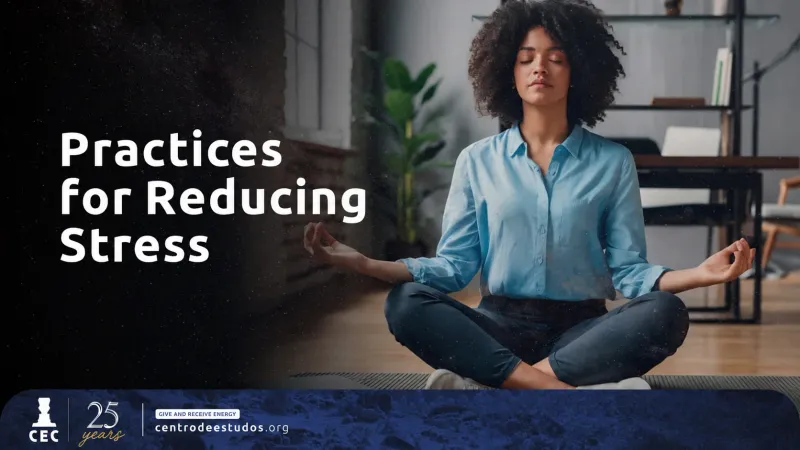
Meditation begins with a posture of wakefulness and attention, maintaining good alignment of the spine and head, along with focus and intention. Release bodily tension, relax your legs, and concentrate on the breathing pattern without changing it. This practice can be performed at any time of day, promoting relaxation and mindfulness. Observe how breathing occurs within your body, what sensations it brings, and use it to promote greater relaxation as you exhale.
Breathing is capable of bringing lucidity to the mind, organization, and energy to every cell, producing physiological changes that are fundamental to our life on the planet. In addition to energetic changes, when we inhale, we bring in prana, the pure energy of the universe, reinvigorating every part of the body. Breathing also acts on the emotional sphere, balancing and organizing us internally and providing greater focus and the capacity to handle any situation. From now on, we will direct this breath toward each part of the body.
First, feel each part of the body. As you inhale, direct the air and energy toward that area, expanding your lungs as much as possible. Upon reaching maximum lung capacity, hold the air for three seconds, keeping the area full of energy. Then release the air, letting go of tensions, blocks, and illnesses and relaxing the region. Keep your mental focus on the breath and its usual frequency. Now bring your attention to the head, scalp, face, sensory organs, brain, cerebellum, and central nervous system.
Perceive the importance of these structures and, on the next inhalation, feel the air filling this region and surrounding all the organs. Hold the air for three counts and release it, letting go of tensions and blocks. Notice how this region feels after returning to your usual breathing, bringing energy and vitality, improving energetic flow and physiological function, and reducing stress, tension, blocks, pain, and illnesses.
With attention and care, focus now on the shoulder region, right arm, forearm, and right hand. Notice the position and level of relaxation or tension in these structures. On the next inhalation, bring plenty of air to this region, as though it were a balloon, filling it with energy, vitality, and vigor. Hold the air for three seconds and, as you release it, relax and bring fluidity and health. Compare the right arm with the left. Now focus on the left shoulder, left arm, forearm, and left hand.
Keep your breathing tranquil and, on the next inhalation, fill these areas with air and energy, holding for three seconds. As you release it, remove pain, tension, and blocks, noticing how this region feels. Return your attention to the thoracic region, front, back, ribs, muscles, organs protected by the ribs, abdominal region, viscera, and pelvis. Direct the maximum amount of energy, filling your lungs and carrying oxygen to these areas. Hold for three seconds and, as you release it, let go of blocks, pain, stress, and tension. Observe how you feel.
Now focus on the right lower limb, thigh, leg, and right foot. Notice the physical posture and energetic aspect of these structures. On the next inhalation, fill them like a balloon, moving through the thigh, leg, and right foot. Hold the air and, as you release it, remove tension, devitalization, illness, and pain. Compare it with the left lower limb. Focus on the left thigh, knee, leg, and foot. On the next inhalation, direct energy to these areas, holding for three seconds. As you release it, remove blocks and tensions, noticing how these structures feel.
Expand your perception to the entire body, observing the level of tension or relaxation. Name what you perceive for greater consciousness. Assess how you feel energetically, whether there are energetic signs, and observe the level of mental activity, seeking greater silence and tranquility. Compare your breathing and heartbeat, performing a global self-evaluation. These practices help focus on the present, perceiving resources for dealing with people and situations.
Now slowly open your eyes. We will exteriorize energy to the spiritual helpers of the Center for the Study of Consciousness. We carry out important spiritual assistance work in which helpers use the energies we donate to assist with healing and in places that have suffered tragedies or wars, encompassing the entire planet. Simply raise your hands, focus your intention on your palms, and feel your best energies flowing through them, mentally directing them to the spiritual helpers. Maintain the intention of helping many people.
Questions raised by this material
- Why does a hectic routine increase stress?
- How does self-knowledge help reduce stress?
- How can I perform lymphatic self-massage to relieve stress?
- How does the evolution of consciousness help people cope with stress?
- How can I use breathing to relax my body?
Keywords
How to cite
Fukuyama, É., & Rodrigues, M. (2024, May 8). Practices for Reducing Stress [Video]. Center for Consciousness Studies. https://centrodeestudos.org/en/library/practices-for-reducing-stress/