Give & Receive Energy

Summary
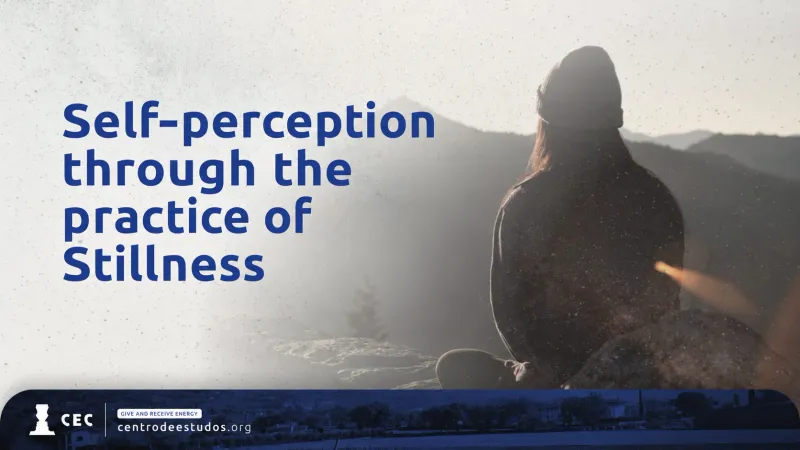
Self-perception involves recognizing the Real Self rather than the Ideal Self by perceiving the body, emotions, thoughts, automatic habits, and our own energies. Stillness practices help us notice these aspects, but seeking inner silence also requires facing internal conflicts and relationship difficulties, because spirituality is connected to behavior. Simple breathing and relaxation exercises and attention to everyday surroundings offer a starting point without needing to master meditation. With practice, perception and the ability to become still develop together, helping us better handle emotions, criticism, and other people.
Source transcript
It is interesting how, when describing ourselves, we choose characteristics that we consider important. This relates to our topic: self-perception through the practice of stillness. We are going to explore how we perceive ourselves and how this connects with our growth and spirituality. When someone asks us "who are you?" the answer may not be so simple. We often construct an idealized image of ourselves, highlighting positive characteristics and ignoring those we do not like. This becomes evident when we receive criticism that bothers us, revealing aspects of ourselves that we do not accept.
Self-perception involves recognizing the "Real Self" rather than the "Ideal Self." It took me 54 years to notice several things about myself. One personal example is my difficulty dealing with irritation in the workplace, especially with operating room staff while teaching doctors and new residents to operate. Despite striving to be more pleasant and less controlling, I frequently found myself acting rudely. This led me to question what I did not know about myself. Freud brought a conception of the unconscious, which helps us understand parts of ourselves that we do not know. On the other hand, I also faced passivity at work, failing to express my wishes, which generated frustration. Even while studying spirituality, I realized that I still had a great deal to learn about myself.
After some time reflecting, I realized that spirituality is deeply connected to behavior. I felt the need to change and try to reduce certain patterns. I understood that I can share ideas, even if they are not originally mine, and express myself without problems, accepting situations as they are. Today, I follow a more balanced path, accepting that each person has their own context and their own reasons for wanting to impose themselves or not.
This learning brought me greater peace. Knowledge, both spiritual and professional, provides a different maturity, allowing us to deal better with various situations. As an adolescent, I wanted things to happen my way, despite intense passivity. Over time, I understood the importance of accepting and adapting to circumstances.
The maturation and understanding we acquire throughout life are fundamental to comprehending the processes we experience. We often behave passively in certain situations, without consciously noticing what is happening. Since childhood, we have gone through various lives, and in each one we need to begin almost from zero in order to understand and learn. For a long time, we are unable to name our discomforts, nor do we know where they come from or what to do with them.
I studied psychoanalysis around 10 years ago, and during that process, which requires us to undergo analysis, I had interesting experiences. I remember a book by Oliver Sacks, "The Man Who Mistook His Wife for a Hat," which addresses neurological issues. In psychoanalysis, I felt something strange: to me, the mental sphere, reasoning, and logic were more important than the physical. I viewed myself as merely a brain, without contact with the physical body. This perception was odd because I behaved as though I were only a head, ignoring the rest of the body.
Self-perception encompasses a broad range of experiences. We begin with perception of the body, feeling pain and tension that we often ignore amid the rush of daily life. We have difficulty identifying our actual physical needs, such as the quantity and type of food we consume. Many people have no sense of what the body truly needs, and this relates to emotional needs. Perceiving emotions is even more complex. We have an "ideal self" that we would like to be, but we face emotions such as envy, jealousy, neediness, and anger. These emotions blend together and complement one another, and, to define them, we need to describe them in detail. I ask: which emotions do you feel that you would not like to feel?
In addition, there is the perception of thoughts, which blends with emotions. Unwanted thoughts often arise automatically. I remember a clairvoyance and astral projection practice at CEC in which we asked people to count from 1 to 10 and, whenever a thought appeared, to start over. Some people quickly noticed the intrusion of thoughts, while others did not notice until they reached high numbers. This practice reveals how often intrusive thoughts occur without our noticing.
The exercise of counting without allowing thoughts to interfere is complex. When we try not to think, we have already generated a thought. Following this exercise to the letter is challenging because the mind tends to become distracted easily. Continuing along the line of the physical, emotions, thought, and perception of one's own habits and vices, it is interesting to observe what we do automatically. On one occasion at São Damião, we welcomed Hans Machado, a specialist in the Feldenkrais technique. He guided us through various exercises and highlighted something curious: when he asked us to stand and cross our arms, I realized that we always cross our arms and perform certain movements in the same way, automatically. I had never noticed that I put my trousers on beginning with the left leg or that I always brush my teeth with my left hand.
It is fascinating how we do many things automatically, without the slightest perception of how we do them. This serves as a shortcut for the brain, which does not need to think about every step. However, a lack of perception of this automatism can be problematic. I have gone to the hospital and ended up at another hospital simply because I was accustomed to following a particular route. Often, when going to pick up my mother or going to work, I follow a familiar route and, without noticing, end up somewhere other than I had planned. This automatism can cause us to lose spatial awareness, especially in moments of desperation or nervousness.
Perceiving one's own energies is fundamental because it is connected to emotions and thoughts. We need to identify what kind of energy we are producing—such as frustration, hurt, or anger—and how this affects our etheric double, causing blocks. For a long time, I did not understand what internal turbulence was, but, when I remained silent, I perceived an internal noise. This perception is essential for distinguishing our emotions and thoughts from those of others and for understanding the meaning of our life.
When I began developing my spiritual side, I thought I could set relationship issues aside, believing that they had no connection to spirituality. However, after joining CEC, I realized that I was creating an illusory reality within myself. To seek balance and inner stillness, I needed to face my internal conflicts. By watching Moisés's lectures, I understood that I needed to seek something more realistic, facing my problems in order to reach inner silence.
Stillness practices, such as meditation and breathing, are essential for dealing with a hectic daily life and the large amount of information we receive. Even in quiet environments, it is difficult to reach inner silence without practice. Exercises such as counting breaths help bring us closer to this silence. Daily life can be very hectic, but it is important to find moments of tranquility.
I read a book by a Vietnamese monk, Thich Nhat Hanh, who discusses walking meditation. The book is titled Walking Meditation: A Guide to Inner Peace. He teaches that we do not need to seek stillness only during formal meditation, but can create these moments every day by paying attention to our breathing and the environment. This helps us circulate more energy and deal better with people, better understanding the message we want to convey and the one we receive from others.
Self-perception can be developed through stillness practices, even without complete effectiveness at first. It is a daily process of self-knowledge in which we accept who we are and seek resources to resolve our internal conflicts. This helps us manage emotions and achieve a fuller life. Consciential maturity allows us to deal better with criticism and improve continuously.
The practice of stillness represents continuous growth: over time, we improve both perception and the ability to become still. We do not need to be masters of meditation to begin; we can start with simple breathing and relaxation exercises. The practice becomes part of everyday life, helping us live each moment fully. In my daily life, I try to observe the environment around me, even on familiar routes. This helps me be present and become better acquainted with people and places. In São Paulo traffic, I take the opportunity to observe and photograph unique moments in the city. These practices broaden spatial and energetic perception, making it possible to sense what is happening around us.
Emotional tranquility makes it possible to live each moment fully. Each person has their own pace, but everyone can find moments of inner stillness, expanding the mind and thinking of new possibilities. Even if this is not practiced every day, it is important to find moments of relaxation for insights and personal growth.
Questions raised by this material
- How do calming practices help with self-awareness?
- What is the difference between the real self and the ideal self?
- How can I become aware of automatic thoughts?
- How can I become aware of automatic habits in everyday life?
- How can I practice quieting my mind in everyday life?
Keywords
How to cite
Fukuyama, É., & Alexandre, J. (2023, March 14). Self-Perception Through the Practice of Stillness [Video]. Center for Consciousness Studies. https://centrodeestudos.org/en/library/self-perception-through-the-practice-of-stillness/