Give & Receive Energy

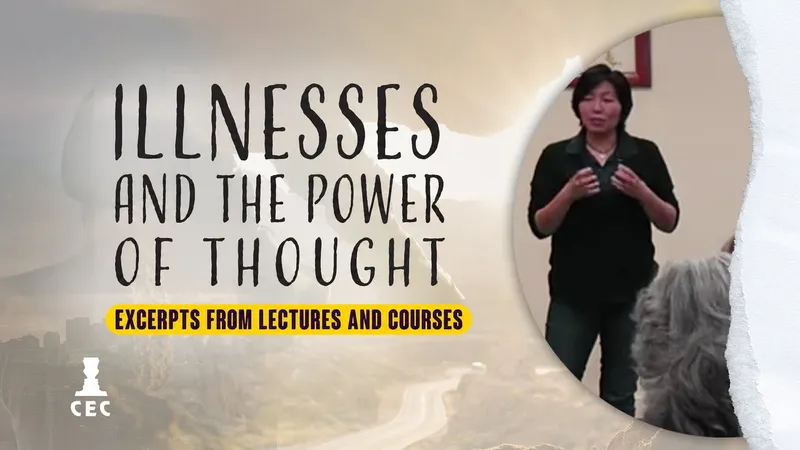
Summary
Gaining admission to medical school at age 16 taught Érica that spiritual support goes hand in hand with personal effort. Diseases such as cancer can develop despite the body's defenses and trigger strong emotional reactions. The experiments cited link thought and emotions to physiological changes. In one, people who centered themselves through breathing and calmness, slowing their breathing and heart rates, altered the conformation of DNA in a test tube; intention alone was not enough. In another, recalling moments of anger reduced salivary secretory IgA levels, which remained low throughout the day. These relationships warrant further research.
Source transcript
Let us talk about physical health. I am a physician, specializing in head and neck surgery. I care for the thyroid, cancer of the tongue, throat, face, and various other parts of the body. I have also studied homeopathy and anthroposophy. My brother was an acupuncturist and now focuses more on homeopathy. Since childhood, I have felt accompanied by spiritual helpers. I believe that many people also have that sense of orientation, protection, and guidance. That presence is comforting.
My father's dream was for me to be a physician. He encouraged me from early on, buying me a microscope and a stethoscope. That dream became mine as well, and I very much wanted to get into medical school. At that time, the USP medical school was one of the most highly regarded, and I worked very hard to get a place. At 16, I made it. In 1986, I arrived at a newsstand at 5 a.m. and waited for the newspaper carrying the results to arrive. I learned that we are capable of anything if we have strength, will, and continuity.
It is not enough to wish for something and expect the spiritual helpers to do everything. It is necessary to work hard. The spiritual world backs us when we apply ourselves. With that achievement, I understood that everything was possible. The spiritual helpers do not help us out of pity, but because we have the capacity to transform what is around us, to improve ourselves, and to bring joy and happiness to the world.
Even if we do not reach the poise of figures such as Gandhi or Martin Luther King, we are moving in that direction. We are here to acquire knowledge, to activate the frequencies of the chakras, and to understand the world more broadly, overcoming our limitations. Often we do not think that we can lose everything that is important to us. When an illness such as cancer appears, the reaction can be intense. Elisabeth Kübler-Ross, in her book on death and dying, describes phases such as denial, bargaining with God, acceptance, and using the illness to receive attention and affection.
Our body is constantly renewing cells. The skin, for example, regenerates quickly. We have genes that control cell proliferation and tumor suppressor genes that regulate that growth. Every day we produce thousands of defective cells, but our defense system identifies and destroys them, preventing cancer. We have a highly efficient organism, with processes of proliferation, DNA repair, and apoptosis. However, sometimes we develop cancer. The book "Soul Medicine," by Norman Shealy, explores how the power of thought can alter the conformation of the DNA.
DNA has a spiraled double-helix structure. In an experiment, scientists used DNA from placental cells, placed in a test tube, and, by means of spectrophotometry, investigated whether the power of thought could alter the conformation of the DNA. They found that it could, because they observed changes in the twisting of the DNA. When DNA twists excessively, it forms chromosomes. The experiment showed that some people were able to alter the spiral of the DNA, but not all of them. Who was able to? People who, by means of breathing and calming techniques, were able to center and balance themselves and to lower their respiratory and cardiac rhythms. Those people, upon reaching an energetic linearity, were able to bring about the change.
This demonstrates how apparently disconnected elements can be related and can influence the laying on of hands. Some people tried to alter the conformation of the DNA with intention alone, but were not able to. Those who concentrated and lowered their cardiac frequency, reaching a state of balance, were able to. Another experiment by the same group involved participants who, for five minutes, were to recall moments of anger and then, for another five minutes, moments of joy. It was noted that, when recalling anger, the levels of secretory IgA—an antibody present in the saliva—decreased and remained low throughout the day.
These findings make the correlation between emotions and physiological changes palpable. It is important that more professionals become interested in this area of research. In Brazil, medicine is still quite conventional and does not explore these correlations, even though there is a great deal of information about the relationship between emotion and illness. However, there are people studying this, which is very promising.
Questions raised by this material
- Can thought change the shape of DNA?
- Why do helpers not replace personal effort?
- How do emotions affect immunity?
Keywords
How to cite
Fukuyama, É. (2015, April 28). Illnesses and the Power of Thought [Video]. Center for Consciousness Studies. https://centrodeestudos.org/en/library/illnesses-and-the-power-of-thought/