Give & Receive Energy

Summary
Aggressiveness, like passivity, is a defense mechanism tied to inner fears: an aggressive person seeks to dominate others through confrontation and may react to people who remind them of negative experiences. Understanding its origins can help resolve it, but extreme cases require help beyond personal effort. An aggressive person must recognize the impact of their actions; normality is balance with oneself and with the environment, and it is possible to express opinions without aggressiveness. Knowing ourselves is also essential to spirituality, since our energies reflect thoughts and feelings, and our personal characteristics attract similar spiritual consciousnesses.
Source transcript
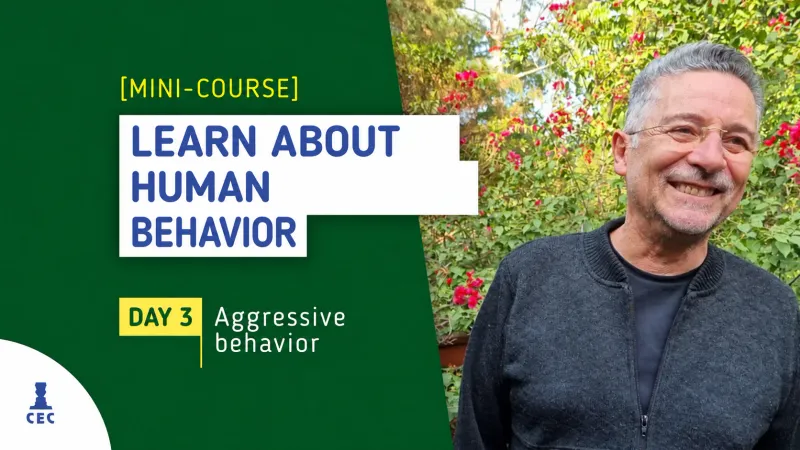
We are on the third day of the course "Learn about Human Behavior." This work aims to spread knowledge about evolution. Evolution, from our point of view, depends on relationships; we do not evolve without them. These relationships are fundamental to growth.
Today, I will talk about aggressive behavior. Recognizing whether you are aggressive is important for understanding the various faces of this behavior. No behavior is simply yes or no; it has nuances. If you have obsessive behaviors, you tend to internalize everything. Hysterical behavior, on the other hand, manifests in the body. The obsessive person hides their actions, while the hysterical person shows their pains outwardly, seeking attention. These characteristics make up passive or aggressive people. We are focusing on the aggressive ones. How do they express themselves? First, with a pointed finger, imposing themselves through shouting. The aggressive person does not accept a "no" easily; they want things to happen their way, dominating the space and the environment.
Being aggressive or passive are defense mechanisms of our psychic apparatus. It is important to recognize whether you are aggressive or passive, because this is related to inner fears. The aggressive person acts preventively, anticipating situations and limiting the other person. Often, they react to people who bring to mind negative past experiences, resulting in aggressiveness.
The aggressive person may move quickly and make abrupt gestures, unlike the passive person, who avoids confrontation. The aggressive person seeks confrontation in order to dominate the other person, transferring their fear. Each of us is unique, responding in a peculiar way to the environment and to situations. There are around 7 billion or a little more people on this planet. Aggressiveness, if understood, can be resolved. We should not try to resolve extreme aggressiveness with personal effort alone, but rather seek help to understand its origins. Small instances of aggressiveness or emotional difficulties can be resolved internally, as in the case of shyness, which can be overcome with practice.
Normality is not what is common, but balance in the relationship with oneself and with the environment. Knowing yourself is essential to spirituality. If you are aggressive, what kind of spiritual consciousnesses are around you? Probably consciousnesses of the same pattern. The spiritual world reflects the physical world according to our characteristics. Calm people who seek knowledge have similar spiritual companions.
When we discuss personal characteristics, we notice that they influence our consciousness and attract similar spiritual consciousnesses. Our chakras operate at specific levels, and the expression of our energies reflects what we think and feel. It is not possible to emanate energies of love without truly understanding love. Responsibility for our actions is fundamental. An aggressive person must recognize the impact of their attitudes. Coherence in our thoughts can be achieved when we free ourselves from dysfunctional emotional contexts. Expressing opinions without aggressiveness is possible, since the aggressive person loads their actions with emotion, just as the passive person does. In the next session, we will address assertive behavior, which is essential for a healthier and happier life.
Questions raised by this material
- How does aggression serve as a defense against fear?
- What are the signs of aggressive behavior?
- When should you seek help to deal with aggression?
- How does aggression affect the spiritual company we keep?
Keywords
How to cite
Esagüi, M. (2013, May 29). Mini-course Learn about Human Behavior, Day 3 - Aggressive Behavior [Video]. Center for Consciousness Studies. https://centrodeestudos.org/en/library/mini-course-learn-about-human-behavior-day-3-aggressive-behavior/