Give & Receive Energy

Summary
Spiritual growth depends on genuine and lasting changes. Change requires motivation to overcome obstacles such as learned patterns, family and spiritual pressures, fears, defense mechanisms, and pleasures associated with addictions. Suffering can drive this gradual change, which requires personal responsibility, firmness without aggression, and respect for different choices. Growth is reflected in more stable reactions and the ability to like people despite differences. Self-assessment should compare our current reactions with our past reactions, honestly acknowledging what we still need to change.
Source transcript
The theme of accelerating our evolutionary process is fundamental: making use of this incarnation for spiritual growth, not merely coming into contact with spirituality to satisfy curiosities, but growing. And growth implies change. Changing is not easy, but it can be. When we talk about behavior, people frequently report difficulty changing certain habits. Some changes seem easy. Why are some attitudes simple to alter while others remain unchanged for years? Understanding the processes involved is important. Our objective is to make the most of this valuable incarnation without wasting it as we have probably done in other lives.
When we talk about change, we mean true change. We often feel that we take one step forward and one step back, getting nowhere; sometimes the feeling is worse, one step forward and two steps back, creating a cycle that is difficult to break. Each person faces different difficulties, but evolution and change go together. There is no growth without change. These must be effective changes, not merely temporary ones. It is easy to decide to lose weight, but it is difficult to maintain that change. The question is: why is it so difficult to truly change? In my view, making real changes is very difficult. We are born into families with patterns similar to our own, and we are raised within those patterns, which seem normal to us.
From an early age, we see behaviors such as fighting, aggressiveness, passivity, excessive eating, and other habits as normal. We grow up with beliefs that shape us. When we go out into the world, we find groups that share our interests and habits. One day, we may gain access to new knowledge or experiences that make us question those patterns—it may be a video, a book, or any material that awakens us to the possibility that the way we were living was not healthy.
When we meet people who live differently, we may decide to try something new. This is not easy, especially when it involves breaking with family or religious beliefs. The difficulty begins when we try to be different from everything that shaped us. In addition to physical groups, we are part of spiritual groups that share our beliefs. When we decide to explore a more open form of spirituality, such as attending a Spiritist center or practicing Reiki, we face obstacles.
They are often not harassers, but members of our own family groups trying to keep us on the path they believe is right. These difficulties apply to various areas of life. In a traditionally meat-eating family in Rio Grande do Sul, for example, deciding to become a vegetarian can be a challenge. Family and spiritual pressure can be intense, with our health and choices being questioned.
Harassment—the kind that intends to harm—must be distinguished from simply not knowing, the ignorance of not knowing. Each person acts according to their beliefs. Behaviors often cause us suffering—and that suffering sometimes acts as a "friend," shaking us up so that we seek knowledge and change. We repeat behavior patterns over several incarnations without making progress. Suffering impels us to want to act differently, initiating a study of ourselves.
When we decide to change, we face the need to mobilize our energies. Whether pursuing a dream or carrying out a daily task, everything depends on this mobilization. A person with depression, for example, has difficulty mobilizing energy and vitality. Change requires motivation and the identification of what drives us. Deciding to stop eating meat or practice astral projection every day requires clear motivation.
Change is like a scale with two pans: motivation on one side and internal and external obstacles on the other. When motivation outweighs the obstacles, change occurs. However, if the obstacles weigh more heavily, change does not occur. It is crucial to identify the elements that make up these obstacles. There is often significant spiritual influence, but we should not blame only spirits or third parties. Each person has a unique energetic and spiritual reality.
One's social composition, especially the family, carries significant weight. We are all born into a group karma, and these relationships are not by chance. Our spiritual origin affects our life, and it is important to understand how this influences our difficulties and fears. Internal defense mechanisms often prevent us from changing, creating sensations such as laziness or sleepiness. These unconscious mechanisms act constantly, making change more difficult.
To overcome these barriers, it is essential to analyze our difficulties and fears. Change can create a fear of losing relationships, friends, or even a marriage. As we change, we may become closer to people with whom we have greater affinity and move away from others. Fear of the unknown can bind us to painful but familiar situations. We prefer familiar suffering to the risk of the unknown.
As paradoxical as it may seem, dense energies generated by negative behaviors fill us and give us a false sense of control. Fear of loneliness or emptiness prevents us from abandoning what is familiar. We wonder what we would be like without conflict or fighting, and what it would be like to follow a path of peace and growth. Behind our behaviors are fears that we need to face in order to evolve.
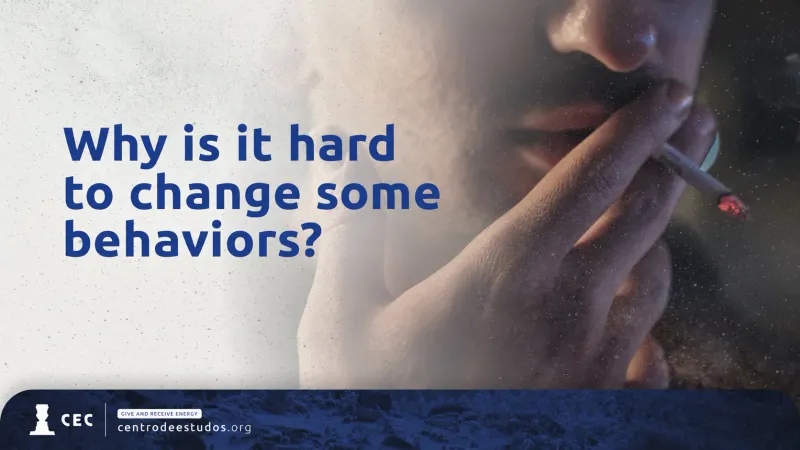
There is also our personal pleasure, which often prevents us from stopping certain habits, such as addictions. When I smoke, spiritual influences are not the only factor; I myself also play a role. It is important not to blame only the family environment or spiritual influences for our behaviors. We need to recognize our responsibility and seek ways to calm ourselves that do not involve addictions such as smoking or drinking. Change is gradual and requires steps taken by us. Over time, our family members, who make up our group karma, may notice our changes and stop putting pressure on us.
It is essential to show everyone around us what our decision is and which path we have chosen to follow. Changes may seem easier when we are not attuned to the family group. When we are in a very similar group, that attunement makes it more difficult to leave. However, even if we do not feel that we belong, there is a reason for us to be in that family group.
Sometimes we may have a more open mindset or past-life experiences that make us feel different. This is common, and even small differences can become highly sensitive issues when we are the one who differs. It is important to show our strength and decision without aggressiveness. When I changed my diet to something healthier after already becoming a vegetarian, I faced resistance because people saw it as radical. However, when we respect other people's choices, we are also respected.
The secret is to walk together with respect, without criticism. Showing that our path is better can generate anger, and dealing with that is difficult. Mutual acceptance is the best path. As for whether a person with a chemical dependency can change: it is possible, but the challenge is greater because of the unfavorable condition caused by drugs. Change requires gathering energies in an organized manner, and outside assistance may be necessary. The level and intensity of use influence the challenges faced.
An important question is how to help people who need energetic and spiritual support but are unaware of it or do not ask for help. The question is whether it is possible to help someone who does not perceive the need for change and whether the person's receptiveness is important for the help to be effective. It is difficult to intervene if the person is not open. Sharing knowledge or spirituality may be useless if the person is not willing to listen. It is important not to be intrusive and to sense whether there is openness to receiving help, avoiding a waste of energy and frustration.
At São Damião, Moisés spoke about the importance of learning to like everyone. From that, I reflected on the difficulty of liking defensive or aggressive people and on the importance of questioning myself about what I feel toward each person. The exercise of the heart chakra is possible only when external differences do not affect us internally. Although differences between people are inevitable, the challenge is not to let them prevent us from liking others.
Within the differences that reverberate in us, we realize that we are not yet completely united with ourselves. I have been making an effort in this direction, although many challenges remain. It would be wonderful to be able to say that I am free, but it is also gratifying to recognize the internal differences. In the past, if someone spoke badly about me, I might feel dissatisfied, even while trying to rationalize it positively. Recently, I learned that someone had criticized me unfairly, and my reaction was one of emotional stability.
I thought, "How can I help this person?" This demonstrates growth because I can compare my current reactions with my past ones. It is essential to be honest with ourselves, recognizing that we will not always react this way, but that it is a continuous practice. Asking ourselves whether we like everyone is a revealing exercise. Imagine ten people in front of you, each representing something different. Do we accept each one of them 100%? Probably not, because we do not yet have that ability, but it is possible to attain it. This is an exercise I propose to everyone: can we answer this question? When we are distant from ourselves, we think that we can, but self-discovery is a long path.
Our fears make us advance slowly, but if we are certain that the unknown will bring discoveries for our growth, we will take larger steps. Our commitment should be to ourselves, comparing how we were with how we are. Another person may be a reference point but should not influence our path. We should look within without being distracted by what is around us.
Our reactions to situations are a good parameter for self-assessment. When we are stable, without internal changes, we can assess our progress. Before, we reacted abruptly; now we react less, until we reach the point of not reacting. Our reactions reflect our emotional condition. Regarding the use of controlled medications, we should not be radical. Some people need to begin with medication to improve their condition. The idea is to be free of everything, but if someone is in a difficult situation and seeks professional help, the use of medication can be a conscious step toward liberation. We should not measure everything by the same standard, because every case is unique. There are differences between someone who uses medication out of necessity and someone who is addicted.
Questions raised by this material
- Why are some habits so hard to change?
- What role does motivation play in changing habits?
- How does fear make it harder to change behavior?
- How can I deal with family pressure when changing my habits?
- How can I assess my spiritual growth?
Keywords
How to cite
Murad, A., & Cabral, P. (2023, May 9). Why It Is Hard to Change Some Behaviors [Video]. Center for Consciousness Studies. https://centrodeestudos.org/en/library/why-it-is-hard-to-change-some-behaviors/