Give & Receive Energy

Summary
Passivity prevents a person from expressing themselves calmly and saying "no," creating emotional charges. Aggressiveness seeks to dominate others and confuses dominance with happiness, which is inner stability. Assertive behavior allows people to express their thoughts, feelings, and desires in a balanced way, without competition or superiority. Being assertive involves being sincere, recognizing when the other person is right, and letting go of the ego. Emotional adjustments may be necessary to achieve a better outcome for everyone. These behaviors are also reflected in the spiritual environment.
Source transcript
In the study of Human Behavior, we first addressed its importance in our lives. Then we discussed Passive Behavior, describing its various shades so that you can analyze yourself and identify your type of behavior. We also examined aggressive behavior, highlighting characteristics that can have a spiritual influence: when someone is aggressive, the consciousnesses and spirits around them also tend to be aggressive. In every case, our spiritual environment reflects who we are.
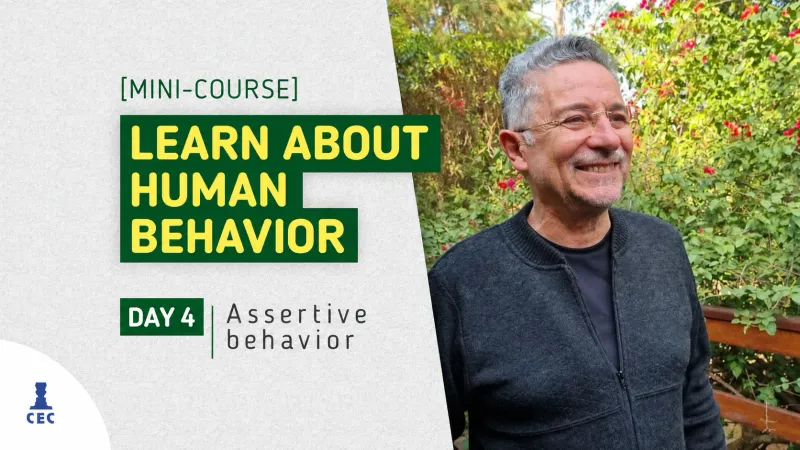
Assertive behavior makes it possible to express thoughts and feelings, expressing points of view in a way that is fundamental to living with more calm and happiness. Before going deeper into it, it is worth briefly reviewing passive and aggressive behavior. Passive behavior prevents the calm expression of feelings and the ability to say "no," resulting in internal emotional charges that need to be resolved.
In life, everything needs to be resolved. Imagine that you are passive and someone says "no" to you. That "no" can sound like rejection or exclusion, generating emotional distress. We cannot live being our own worst company. Even aggressive people, who believe that subduing others brings happiness, are mistaken. Happiness is inner stability, not emotional ups and downs.
Many people think that we must subdue others or that our life ends with the death of the body. However, I think the universal consciousness, which coordinates everything, created an architecture within this universe that promotes growth and evolution. We do not make progress by subduing or by being subdued. I think sincerity is essential: being sincere with yourself and with others is vital, even if at times it requires emotional adaptations in order to reach a better result for everyone.
Having goals that include everyone in the best possible way is important. I once heard in a TV interview that there is no such thing as an assertive person, because such a person would be aggressive. I respect that opinion, but I believe that assertive behavior is balanced. It makes it possible to express thoughts and desires adequately, without effort to maintain harmony. The assertive person does not seek competition or superiority. If you catch yourself competing, it is time to reflect and adjust your behavior.
The assertive person says what they think and acknowledges when the other person is right, accepting ideas without operating at the level of the emotions, but rather at the level of the feelings and of detachment from the ego. It can be difficult to find assertive people, but they exist and can serve as models. What matters is to seek inner balance in order to express thoughts without competing, living without brooding over issues.
Obsessive and hysterical behaviors are also problematic. The obsessive person carries on inner dialogues, hiding flaws and fears, while the hysterical person turns everything into an illness in order to attract care. This work on human behavior is not simple, but it is essential for our growth.
Questions raised by this material
- What is assertive behavior?
- How does detachment from the ego promote assertive behavior?
Keywords
How to cite
Esagüi, M. (2013, May 29). Mini-course Learn about Human Behavior, Day 4 - Assertive Behavior [Video]. Center for Consciousness Studies. https://centrodeestudos.org/en/library/mini-course-learn-about-human-behavior-day-4-assertive-behavior/