Give & Receive Energy

Summary
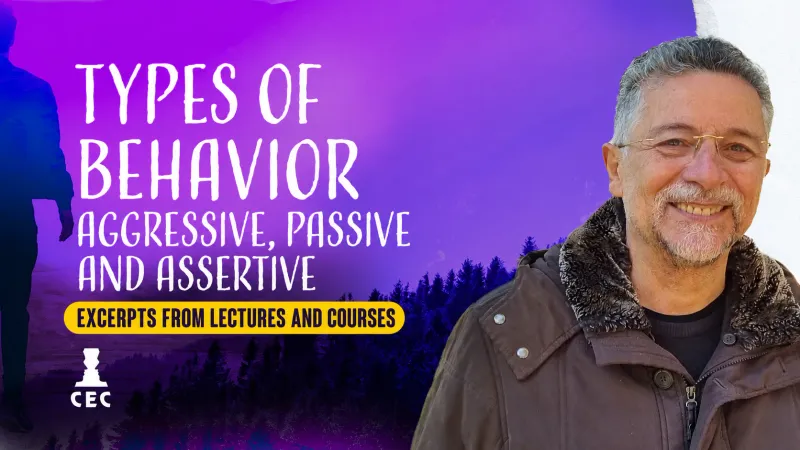
Assertiveness allows people to say “yes” and “no” clearly, without manipulation, doubt, or guilt, as well as to express opinions and accept disagreement. A passive person internalizes emotional charges, which can cause physical illnesses, and explodes when they reach their limit; an aggressive person reacts from the outset, seeks to dominate their surroundings, and exhibits obsessive behaviors. These patterns harm relationships and the energetic environment, and changing them depends on personal effort.
Source transcript
The passive person generally remains passive and only reacts aggressively when they reach their limit, at which point they explode. The aggressive person, on the other hand, reacts with aggressiveness from the start and sometimes becomes passive afterward. The assertive characteristic is different. In the emotional context, we are talking about assertiveness, but there is also a spiritual context. Living in absolute assertiveness is the ideal: when the "yes" is really a "yes" and the "no" is truly a "no," without manipulation or doubt.
One should not say "yes" merely to please, or later question whether one should have said "yes." In the same way, one should not say "no" and then feel guilty. The assertive person sees things clearly, beginning with themselves and then with others. The aggressive person, on the other hand, needs to dominate the environment and, spiritually, invades it with their energies. The aggressive person consumes emotional charges and, at some point, takes it out on someone; the passive person accumulates these charges and internalizes them, which can result in physical illnesses.
The passive person tends to have more illnesses, because they internalize emotions, while the aggressive person displays obsessive behaviors, trying to resolve everything at the level of thought. The obsessive person does not accept a "no" and takes everything to the ego—both the aggressive person and the passive person do this. Assertiveness involves checking the situation without clashes or confrontations of energy. Both the aggressive person and the passive person have difficulty talking without emotional charges. It is important that conversations not be emotionally loaded, because that destroys the environment.
In a healthy world, it is essential to be able to express opinions and to accept that the other person may disagree. Forcing someone to be like you is a form of violence. In critical situations, such as when a son says he will go out and return at 4 a.m. or not come back that night, it is important to approach the situation with calm and dialogue, without lectures or impositions. When talking about it, it is more effective to express concern openly about his possible involvement with drugs and to trust the son, instead of imposing rigid rules. Even so, if you are passive, you will keep chewing it over all night long, awake, getting up every ten minutes and calling your son. Assertiveness makes it possible to handle situations in a balanced and healthy way.
The truth is that you are worried. Your attitude is aggressive or passive, and that does not bring happiness. What you transmit to your family and to those around you is exactly who you are. Your energetic environment is extremely negative, but you do not notice it. What really matters is behavior change, if we want to transform the world and be happier and better. Often, we imitate others and ask for help from saints and consciousnesses we consider evolved, as if they were concerned with taking care of us. However, all of us have the intelligence needed to change our own lives. The only difficulty is personal effort. That is what really matters: our effort.
Questions raised by this material
- What is the difference between passive, aggressive, and assertive behavior?
- How do aggressiveness and passivity affect the energetic environment?
- How can you communicate assertively with your children?
Keywords
How to cite
Esagüi, M. (2013, May 23). Types of Aggressive, Passive and Assertive Behavior [Video]. Center for Consciousness Studies. https://centrodeestudos.org/en/library/types-of-aggressive-passive-and-assertive-behavior/