Give & Receive Energy

Summary
Passive people avoid confrontation, while aggressive people invade other people's space; both behaviors are responses to internal fears and become habits. Assertiveness involves listening, seeing clearly, and using good judgment to find solutions, without trying to be right at any cost. Respecting differences does not mean accepting yelling, mistreatment, or behavior that causes suffering: you need to point out these behaviors calmly and take an appropriate stand. Relationships are also influenced by emotional charges from childhood, which affect how authority figures are perceived. Understanding these charges and doing inner work help build healthier relationships.
Source transcript
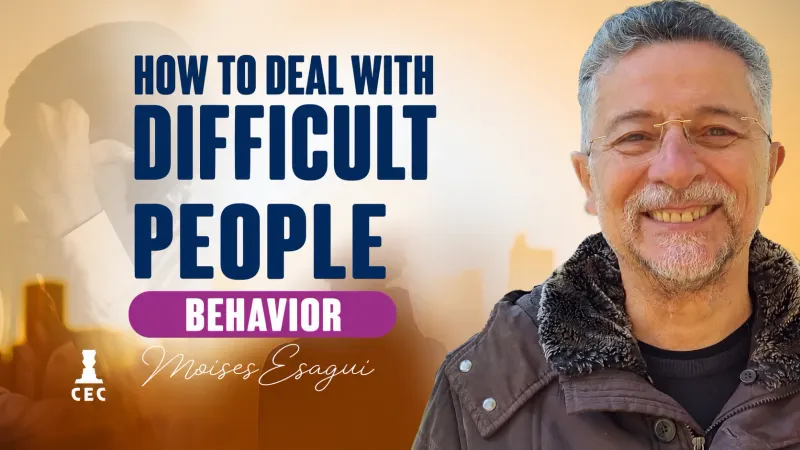
Today's topic is how to deal with difficult people. Relationships involve communication and, many times, that communication is impaired by each individual's emotional context. From childhood on, we carry emotional charges that influence our relationships. Understanding this is crucial.
In courses on assertiveness in relationships, I address three primary characteristics of the human being: passive, aggressive, and assertive. These characteristics help us understand why we face difficulties in various areas of life, such as at work and in romantic and social relationships. The passive person is the one who avoids confrontations, always says yes, and does not make eye contact. One example is a schoolmate who used to hide behind the student in front of him, even though he was seated in the last seat, so as not to be noticed. He had difficulty reacting normally to situations, possibly because of family problems. Passivity is not a matter of being better or worse, but rather a characteristic that can be changed in order to improve one's life.
The aggressive person invades other people's space, speaks loudly, and does not listen. Often this person holds a management position and acts that way because of emotional difficulties, similar to those of passive people. Both characteristics are responses to inner fears. Practice makes perfect, and both passivity and aggressiveness become habits. The assertive person, on the other hand, listens, sees clearly, and seeks to resolve issues with common sense, without wanting to be right at any cost. This behavior leads to a healthier relationship and to fewer emotional illnesses, such as depression and dissatisfaction.
In the context of dealing with difficult people, imagine a marriage in which a passive person is in a relationship with an aggressive one. This emotional complementarity is harmful, because we have not learned to handle it properly. The lack of guidance from childhood on contributes to this dynamic. Should we accept people as they are? In spirituality, there is the idea of accepting, but I believe there are limits. When a relationship affects getting something done, it is necessary to take an assertive position. In a couple, for example, an aggressive and disorganized husband may not notice his passive wife, who suffers. One of the two may fall ill, usually the man, who somatizes more easily. However, all of this can be adjusted.
We should reflect on accepting people as they are, because each situation requires a specific behavior. If your boss shouts at everyone, I ask: should you accept that behavior? Of course not. He needs to see himself and not cause suffering to his colleagues. Someone may argue that he is productive and hardworking, but we are not talking about productivity, but rather about relationships. A person can be productive and still have common sense, which is fundamental in human relationships.
Common sense is essential. People need to be treated with respect. Otherwise, the mistreated person suffers because the aggressor does not see the other person and always thinks he is right, preventing any dialogue. Assertive behavior can greatly improve relationships. Bad-tempered, rude, aggressive people who are full of hurt need to be confronted with their own image. This is beneficial, because they often discharge their repressed emotions for no reason. Pointing this out calmly can improve relationships, which become healthier without emotional charges.
Emotional charges arise when we want our ego to prevail, when we seek to be right, or when we raise our voice. To avoid them, you need to talk naturally, without caring about who is right, but focusing on solving the problems. To achieve assertiveness, inner work and knowledge are necessary. We may perhaps not achieve the perfection of assertiveness, but we can come close to assertive characteristics by opening our heart to accept both a "yes" and a "no." We are not here to assert our ego, but to take a position appropriately, even when facing inconvenient people.
We should respect everyone, but also take a position appropriately, especially when authority figures intimidate us. Learning to take a position is fundamental, because we have the right to express ourselves appropriately in any relationship.
The presence of an authority figure can be intimidating, invading our psychic space and, at times, paralyzing us. It is essential to learn how to deal with these figures. Regardless of whether the person is calm or not, some, even in high positions, treat everyone with respect, which is ideal. Others, once they take on a post, may become unpleasant. In any situation, it is crucial to know how to deal with authority figures in order to avoid suffering. To do that, it is important to understand the meanings we assign to these figures. For example, if you had an aggressive father or mother, or suffered with a teacher who shouted or an authoritarian colleague, these experiences need to be understood.
In this way, we can see the world around us more calmly and seek a path of happiness. We should not mistreat anyone, neither people, animals, nor plants. We should take care of the planet, our home, thinking of future generations. Leaving the body and having spiritual experiences is, to me, something very normal.
Questions raised by this material
- What is the difference between passive, aggressive, and assertive behavior?
- How can you be assertive when dealing with difficult people?
- To what extent should we accept people as they are?
- Why can authority figures intimidate us?
Keywords
How to cite
Esagüi, M. (2017, March 6). How to Deal With Difficult People (Consciousness and Evolution Program) [Video]. Center for Consciousness Studies. https://centrodeestudos.org/en/library/how-to-deal-with-difficult-people-consciousness-and-evolution-program/