Give & Receive Energy

Summary
Emanuel Swedenborg united science and spirituality, viewing study of the material world as preparation for understanding what is hidden within human beings. His work across several fields invites reflection on contributions to the collective and the difference between information and lived knowledge. For 27 years, he recorded dreams and experiences on the spiritual plane; third parties investigated accounts of his phenomena. His work needs to be read in its historical context: he proposed a nonliteral reading of the Bible and described life after death on different levels, where people unite through affinity and continue to be who they are.
Source transcript
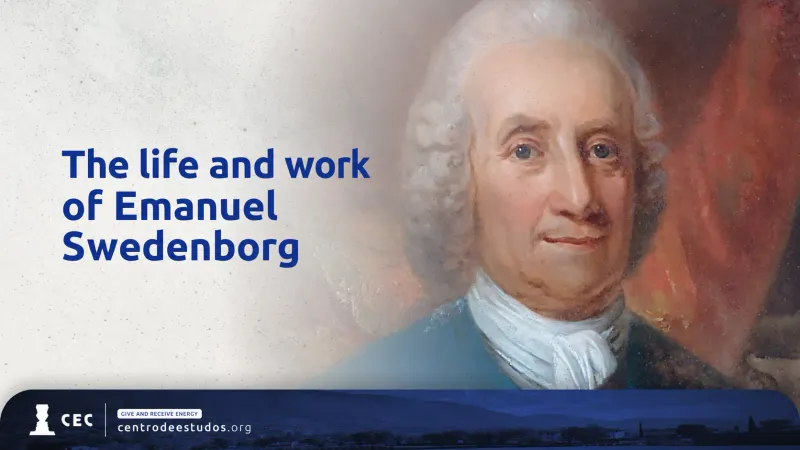
Swedenborg was born in 1688 in Stockholm, Sweden, and lived a relatively long life for the time: he lived for 84 years. He grew up in a religious family that was influential in the community—his father was a pastor in the Lutheran Church and also a university professor, which brought Swedenborg into contact with environments of knowledge from an early age. He was already part of this environment at age nine.
When his father died, Swedenborg was already an adult. The queen granted the family a noble title posthumously in his father's honor, changing the ending of the surname—I do not recall exactly, it was something like "Swedberg" and became "Swedenborg"—to indicate the new status. This allowed Swedenborg to assume a seat in parliament, a privilege reserved for the firstborn son, and work on behalf of the community.
In addition to the religious education that never left him, Swedenborg devoted himself to different fields of knowledge. He was a polymath—someone with advanced and profound knowledge in multiple fields, not merely a curious reader. A comparable example is Leonardo da Vinci, who built flying machines and submarines, painted, and studied anatomy. Swedenborg followed a similarly deep and broad path.
His contributions include approximately 70 works written in Latin, the language most commonly used at the time for intellectual productions. He is cited as someone who had astral projection experiences—the conscious departure from the body while a person sleeps, a spiritual phenomenon. The consistency of his spiritual search, especially considering the context of the era in which he lived, is what makes his biography relevant to those who study spirituality and consciousness.
Even though Swedenborg devoted himself intensely to science, he never disconnected from spirituality. On the contrary, to him, science and reading the world were ways of understanding divine creation, which is the physical plane itself. One of his statements illustrates this: "I was introduced to the material sciences and studied them for 30 years. In this way, I was prepared to understand the things that are deeply hidden within human beings and to serve as an instrument for unveiling them." Knowledge of the reality around us needs to be deepened so that we can truly understand life.
He did not remain with appearances or superficial ideas. He delved into every field of knowledge: he studied geology, biology, astronomy, psychology, theology, and 15 additional fields. This is highly significant. It is not a matter of worshiping titles, but of recognizing the dedication, the work, and how his life was constituted—a great example. Swedenborg was an inventor, philosopher, theologian, and politician. He made a sketch of a flying machine that was not put into practice at the time, but it was later determined that everything he designed would have worked—it would be considered the first airplane. He invented various things in this field of mechanics. He was also a pioneering discoverer: the first to propose the nebular hypothesis for the creation of the universe, half a century before Kant and Laplace.
He made major contributions to medicine. Only in 1968, after some translations—because many things were in Latin—did the American Medical Association recognize Swedenborg as a pioneer in medical research, including the discovery of the brain's irregular movement and the functioning of the endocrine system, among others. Mentioning these contributions helps convey the magnitude of his work.
Connecting this with our daily lives: everyone here is a certain age and can ask themselves, at their current stage, what contribution they have made. If we believe that we have a greater purpose—and perhaps everyone here shares this idea of a greater purpose and of not living only for oneself—what has my contribution to this greater whole been? To the collective? To the planet, this home we inhabit? It is not only a matter of helping another person as an individual, but also of contributing knowledge, because all of us are potential producers of knowledge.
Within the lifetime I have—whether I am 30, 50, or 70 years old does not matter—what have I produced? When we look at a person who, at just over 50 years of age, had already produced a large portion of everything we have mentioned, in more than 20 fields of knowledge, and spoke nine languages because he was a polyglot, we think: perhaps I have been unable to contribute even to one field, while this person followed a path that enabled him to contribute to countless fields.
One interesting fact is that Swedenborg was a vegetarian. In some way, this is something worth reflecting on because taking that position at the time demonstrates different thinking; it was certainly uncommon. Today, we are bombarded with information in daily life; we simply keep absorbing it, thinking that we are absorbing it. We receive one piece of information after another and, at some point, stop internalizing things and engaging in the process of reflection.
When we see a person who did everything he did, within the context of information overload in which we live, we end up watching a livestream and saying, "Oh, that guy is kind of interesting," and then close our eyes and forget everything. Our life needs to bring awareness of what it forms: does what I encounter, or what this person did, bring uneasiness that causes me to review my own life and realize that perhaps I could do more, that perhaps I am moving a little slowly? Maybe it does, maybe it does not. What matters is being attentive to everything that can serve our lives.
Nowadays, there is a widespread idea that knowledge is at our fingertips: you pick up your phone, search Google for who someone was or what something is, and receive an answer. But that is only information. Knowledge is a relationship you have with something. That is why knowledge cannot be placed inside you; it has to be lived by you in some way. You can read every book on astral projection, but that will not make you a lucid astral projector. Coming into contact with information that adds something is an excellent path, and we should do so and nourish ourselves with these things—but we cannot have the illusion that we truly know the subject. We come into contact with information; knowledge is when you become that thing at some level. It is good to pay attention to this.
Swedenborg's life is very curious when we observe how he ultimately produced so much. In this sense, it is important to discuss the historical context in which he lived. It was a period that valued scientific thought: religion and God explained many things, but they also brought mysticism and limitations. Reason was highly valued. This is the context in which he was situated.
René Descartes, 38 years before him, established the foundations of rationalism. Within all his rationalism, he managed to prove the existence of God in his famous book "Discourse on the Method." It is interesting to note that, even at a time when reason was so highly valued, and even while following the path of the science then taking shape—a form of scientific thought different from what we know today—he did not stop turning his attention to spirituality. He sought to understand the material deeply in order to unveil this complex reality.
That is why it is very important to consider that every person is always a product of their own historical context. I could be an extremely advanced evolved consciousness. You could have an extremely advanced evolved consciousness. But that consciousness will have to speak the language of those around it. It is like you having a PhD in something and talking with a two-year-old child. How do you talk with a two-year-old? You have to perceive the child in order to communicate.
Truth follows a winding path. Various consciousnesses who pass through Earth follow this path very gradually. If a consciousness can bring a great deal of information, it is always bound to its own historical context. It will never be able to say things that go far beyond it because, even when it does speak, it will suffer the consequences of what cannot be understood.
I offer this reflection to consider Giordano Bruno's situation. At that time, he said a series of things that ran counter to the principles of the Church. As great as his contributions were, they could not be understood. So he was burned. When you read something and think, "This man said some mystical things; that other one said some strange things; it must all be wrong," you need to understand that you must always read or seek to learn about that life or that thought within the context in which it arose. In this way, you have a greater chance of obtaining more information.
Let us discuss his contact with spiritual life, the terms he uses, and the paths he uses to explain certain things—within what people at that time wanted to understand. There is an account from his childhood of seeing spirits and interacting with them. Indeed, from the time he was a child, his parents reported that he would be playing in the garden and had companions there. He would return to his parents and say, "I was talking with certain people, and they told me this and that." His parents reported that these were very complex ideas that did not correspond to a child and often left them speechless.
Another interesting piece of information is that, at four years old, he was already thinking about existential questions and the meaning of life. Four years is very young. When he grew up, he delved into science, devoted himself intensely, and made major contributions. One of his ideas when studying anatomy was to discover where the soul was. This was a time when the world believed that everything could be measured and understood. He therefore needed the elements to discover where the soul resided. Swedenborg immersed himself in study and produced extensively; there are accounts of him spending days on end working.
One particular night, he was in London. He had just finished dinner. I will read an excerpt in Swedenborg's own words: "I dined very late at my modest lodging, where I had reserved a room so that I would be free to meditate at will. I felt hungry and ate with a great appetite. After the meal, I noticed that a kind of fog was spreading before my eyes, and I saw the floor of my room covered with horrible reptiles, such as snakes, toads, lizards, and others. I was filled with astonishment as the darkness increased. Then I clearly saw a man amid a vivid and radiant light, seated in the corner of the room." The man then said to him, "Do not eat so much."
Swedenborg describes this in much greater detail here, but one thing scholars of his work report is that it did not necessarily have to do with his eating too much at dinner, although that is highly symbolic, but with his feeding too heavily on science. Feeding too heavily on science meant that he was not being led precisely toward the path he should follow. It was at that moment that he had a revelation.
He says that the gates of heaven and hell opened, in the sense that he saw the spiritual plane: what was good and what was not good, at all times. The most interesting thing about the strength, persistence, and will of a person like this is that from that day until the end of his life—a period of 27 years—he wrote down everything he saw on the spiritual plane every day. He made daily records of these visions and this interaction with the spiritual plane, as well as of his dreams—something very curious because recording dreams was not a custom at the time.
Jung and Freud emerged many years after Swedenborg, some 150 years later. Swedenborg died in 1772. He was already presenting interesting elements about the use of dreams as a tool for self-knowledge and a form of communication with the spiritual plane. It is very common for a person destined to fulfill a significant spiritual role to have a milestone in their life. They live their life in a particular way, but at a certain moment they have a striking experience that makes them turn completely, or primarily, toward spirituality.
This reminded me of Moisés's story: in that conversation of his with Jorge, the encounter with those consciousnesses was a striking moment in his life, one that turned him toward assistentiality and the work he had come to do. In Swedenborg's case, that was the beginning, the change of direction in his life. Swedenborg has three main accounts, the best known of them. The first concerns Queen Ulrika — I am not sure of the exact pronunciation. They had a close relationship, and her brother had died. Her brother was the king of Prussia, and Prussia and Sweden did not have good diplomatic relations, so they communicated secretly through letters—no one knew.
When her brother died, the queen asked Swedenborg whether he had any news of him. Swedenborg replied that he did not, but that he would let her know if he received anything. About a week later, Swedenborg went to speak with her and said that her brother would continue writing letters. She was astonished because no one knew that they exchanged letters—it was secret. After this event, Swedenborg also produced some letters through psychography containing messages that her brother sent directly to her. This was one of the spiritual phenomena investigated and verified by third parties. Kant himself, who lived at the time, was among those who researched Swedenborg in an effort to verify all the facts.
Another interesting case involves a jeweler. A man's wife had become a widow, and the jeweler was charging her for a piece of jewelry that her husband had given her before he died. She knew that her husband had paid for it, but she could not find the receipt. She sought Swedenborg, who did not usually do this type of thing, but she was desperate. Swedenborg replied that her husband said the receipt was inside a particular drawer. She said that she had already looked there and that it was impossible. He then added that the drawer had a false bottom and that she needed to look inside it. She did not know this, looked, found the receipt, and took it to the jeweler, who had already received the payment. This is another well-documented individual case.
A third very interesting case is the fire in Gothenburg. Swedenborg was at a dinner, I think at court, in Gothenburg and, while he was there, began describing to the people a fire occurring more than 400 kilometers away on his street, near his home. He kept describing everything that was happening. He said, "Now the fire is at this location; now it is three doors away from my house." Two days later—communication was different at the time—news arrived about what had happened. People confirmed both the time and the sequence; everything he described in detail was reported in exactly the same way. He was seeing everything at a distance and reporting it at the very moment it occurred.
For those of us who discuss clairvoyance, astral projection, and all this content, we know that these phenomena are entirely achievable. But obviously, at that time, having people with such an advanced level of perception and the capacity to produce all of this was something that stood out greatly.
A listener commented, “he seems to be Da Vinci's reincarnation.” Indeed, the number of inventions he made and the level he possessed, in various respects... Of course, we need to be careful when speaking about an advanced consciousness: when a consciousness produces something beyond the ordinary, we may tend to consider it an advanced consciousness. We speak about consciousnesses that truly reside and operate through the higher chakras. In my humble opinion, there is indeed a strong tendency that he was an advanced consciousness, or at the very least that he worked very well with the higher chakras—whether or not he resided entirely in them—but he worked with them very well.
This is not only because he managed to produce work in various fields of knowledge, but also because of the focus on spirituality in everything he brought and the consistency of the proposal he developed through all his spiritual productions. There was a certain consistency in moving away from the Church's perspective, but with greater questioning. When he presented a vision that God or Christ would have revealed himself to him with a mission—the mission of bringing a new view of scripture, bringing forward things that are hidden and that people are not seeing—that is significant. Important messages exist, but within the way they were presented, people are not seeing what matters; they are trapped in the literal interpretation.
The author in question produced, if I am not mistaken, approximately 40 texts using a reading approach that was not literal. He began this work on the entire Bible but did not complete it or reach the end. He wrote several books, and the two principal ones would include "Heaven and Hell"—a single book—in which he describes how spirits and consciousnesses live on the spiritual plane.
He describes what the life of spirits is like outside this physical plane, presenting a completely different viewpoint from what one might imagine because he does not present opposites or the classic polarization between heaven and hell. He says that reality exists in various layers: there are several hells, from the lesser ones to the worst, just as there are various levels of what is good. You will encounter the level at which you are, in a certain sense—that is what he implies. He writes about affinity: people come together by affinity.
One very pertinent statement he makes is this: when we die, we will continue to be what we are. That was impactful to me. Within religious thought, especially older forms, it is believed that you die, you are a Christian, and you go to heaven. That is not how it works. You will encounter what you are; you continue to be what you are.
This was highly revolutionary for the time. Remember that he was persecuted and severely criticized as though he were a heretic at the time, but he was not. He described himself only as a servant of God. See how much tact is required to engage in dialogue with what exists and help make the future different. Arthur Conan Doyle, known as the creator of Sherlock Holmes, conducted an entire study of spirituality from Swedenborg through the 20th century. The first chapter of his work is devoted to Swedenborg.
Questions raised by this material
- How did Emanuel Swedenborg connect science and spirituality?
- What is the difference between information and knowledge?
- Why consider the historical context when reading Swedenborg?
- What is life after death like according to Emanuel Swedenborg?
Keywords
How to cite
Cabral, P., & identificada, C. C. N. (2023, May 19). The life and work of Emanuel Swedenborg [Video]. Center for Consciousness Studies. https://centrodeestudos.org/en/library/the-life-and-work-of-emanuel-swedenborg/