Give & Receive Energy

Summary
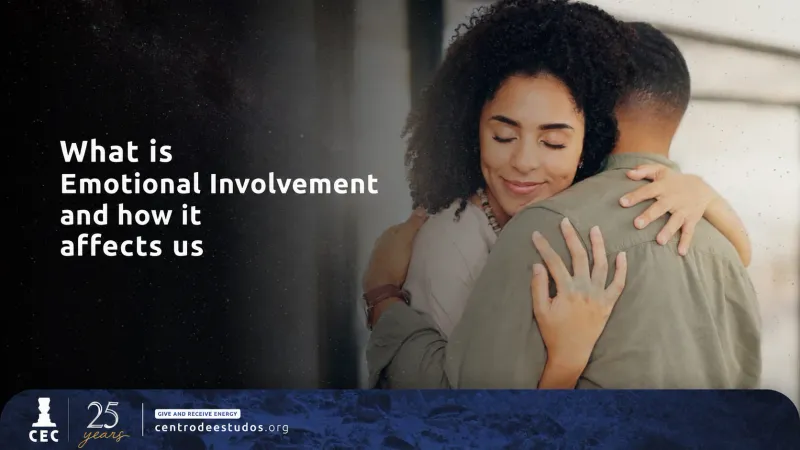
In our interactions with others, we assimilate their emotional and energetic aspects in a reciprocal exchange: happy people promote well-being, while anger, resentment, and complaints wear us down. In romantic relationships, passion clouds perception and fuels attempts to reshape the other person to fit an idealized image. Happy relationships are built over time through conversation, understanding, affection, maturity, compatibility, and similar goals, allowing both people to grow without excessive dominance or control. Putting spiritual knowledge into practice in everyday life contributes to healing and happiness.
Source transcript
Today's theme is "What We Absorb from Others When We Live Together." We are going to talk about relationships. A long time ago, around thirty-five to thirty-eight years ago, I was reading a book in which someone said the following: let us suppose there are two people, one very intelligent and the other with many emotional difficulties and a rather foolish, somewhat dulled mental capacity. If these people began living together, the person with more problems would improve, and the one who had greater ease would have more difficulties by the end of the story. That was a psychological analysis. I kept wondering: but is that true? Can that really happen?
After studying so much, we realize that people absorb what is close to them through their relationship with others. It is important to know that if you live with very happy people, you will become happier; if you live with sickly people who are full of problems, depressed, and always in a bad mood, they will transmit to you what they are.
I always repeat this: if you are in an exceptionally good mood, extremely happy, I give you a score of ten. There you go, ten for someone who is very happy, is at peace with life, at peace with themselves, with others, with everything. And there is a person who lives with you who is very ill-tempered and unhappy. Their score is four. Assign a score; this is only a supposition. If you spend time with them, adding these energies together, your score will become seven, while theirs will rise from four to seven. Just look: your score will become seven! What happens is that you feel less energetic and unhappier, because your score was ten and you can perceive the difference.
And the ill-tempered person whose score was four will say, "Wow, you make me feel so good!" To me, that is really something. We need knowledge of the emotional and energetic aspects in order to make our lives happier. That is why I believe that deeply involved romantic relationships between a man and a woman need a shared path, understanding, and the same goals so that people can grow. If someone does not grow, they do not evolve; they remain stuck in place and get nowhere. In a relationship, each person has to help the other. But for one to help the other, I think there must be affinities, the same goals, and many points of emotional connection.
Each person's little compartments need to be more or less resolved. I think that is fundamental. What frequently happens is that we end up with a very unhappy person. For some reason, we see them the way we want to and tend to want to reconstruct the other person into the image of what we need. I do not consider that a good idea.
I will now use romantic relationships as an example based on one quality a person may have, because that makes it easier for everyone to understand and easier for me to explain as well. Let us suppose that a man sees a woman and that, to him, she is physically very beautiful. He thinks she is the ideal woman. He starts talking to her, and then they begin exchanging energies, which I call exchanging little balls, those that move from one person to the other. At first, these little balls are highly potent because they are much more closely connected to passion, desire, neediness, and necessities. This is the base chakra.
I am talking about the base chakra because that is where most people begin a relationship, not somewhere else. I am not saying everyone does. Because there is intense emotion, that emotion will cloud things considerably, enough that you will not want to lose what has been formed. So you will see many people say, "Wow, when I first saw this person, I felt something inexplicable." The other person may say the same thing, or they may not. But, in fact.
This is the beginning of a relationship with a very high potential for passion, which you will try to maintain by making the person into the one you initially saw and endowed with a host of positive characteristics. You will therefore think that the person is wonderful, smiling, happy, and cheerful. Yet the person may be disagreeable, ill-tempered, or may not even like you. That was her moment, but we try to maintain this position by talking, conversing, saying that they are wonderful, and saying, "Goodness, do you remember when we started? Was it not great?" Starting is different from continuing. Everyone starts something, but continuing is the difficult part.
First, you need to have energy for it. Perhaps you need strong motivation and, above all, the inner determination of someone who is certain of what they want. It is not easy; I do not see it as simple. Since we are talking about energies, what happens is that this relationship, which began with a powerful emotional drive—a high energetic drive—will eventually deteriorate. Even so, we try to maintain it. Observe the level of energetic exchange. How will you remain in this relationship? People often say that the enchantment is fading. No, there was never anything real in the relationship.
Happy relationships need to be built over time, with a great deal of conversation, a great deal of understanding, and similar goals, along with affection, awareness of the other person, and the intention to mature, which is not so easy. This is fundamental in our lives because, otherwise, your life becomes very bad. We form our relationships in such a way that, honestly, if you live with someone who is not so good, over time you will discover that your life will not be the same.
That is why many people prefer to be alone, because then they can manage their own energies once they are more resolved. Making life happy and sensible and guiding it in the direction you believe is right can lead to greater growth. I once saw an actress say that every time she became involved with someone, her work suffered greatly. Yes, it did! The energy we have and the path we follow cannot be diverted by other energies. You therefore need to be very attuned to someone in order to grow, be happy, and build your own life.
There should not be that issue of, "This person is more aggressive and I am passive," or, "I am more aggressive and she is passive." A relationship between two people must be balanced; that is, each person's participation cannot greatly dominate the other or control them excessively, because that generates an energy that will be difficult to manage. I am not talking only about spiritual energies but also about emotional energy; you will need to control yourself and do the best you can. That is not happiness, is it?
There is one detail I would like to mention: if you live with someone who is ill, it is quite likely that, although they have an illness, they are very happy, because some people, despite not being in good health, remain focused on what is positive, happy, and good. For one reason or another—which can be addressed another time—they did not get well. In fact, when we need to care for another person constantly, we end up not being well ourselves. That is true.
If you live with someone whose disposition is already negative, filled with anger, rancor, and resentment, someone who causes their own illness and uses the illness as an excuse, over time you will become ill alongside them, because it is not possible to have things that are not good around us and remain well. Maintaining that will require a great deal of energy. It is much easier, for example, to live with happy, cheerful people in environments with immanent energy, full of vegetation and good things, and to remain well and happy.
We are destroying the planet, creating things that make no sense, and in the future we will discover that we have destroyed everything, including ourselves. It is an unhappy situation, but it is what we do. This learning will lead you to an inner happiness that is very important in our lives. To heal our lives, we must make an effort and cause these energies to circulate so that we become happier. Stagnant energy is illness; that is why we need to learn this. The people who need this work will receive energy; countless healings have already occurred. It is important to know that people feel better and become better able to continue their lives and follow a path of evolution and growth, but we need to give them a chance.
Our ignorance hinders us greatly. What we absorb from others when we live together is a recurring theme, because it concerns energy and relationships. Relating to happy, cheerful, good, and good-humored people makes you feel better. A relationship with someone who is unhappy, sad, only complains about life, and sees everything as a problem is different. Some people have a small problem but manage to turn it into something enormous and boundless. Others, by contrast, receive a large problem and reduce it to something small. It is all right; we will solve it.
We need to see which side we want to be on: turning small problems into monsters or reducing large problems to nothing. Happiness means seeking, at every moment, what is best for our lives and for the lives of those around us. To do that, we need to nourish ourselves constantly with what is good. What we absorb from others when we live together is everything they are, and they absorb everything we are. In the final tally, after adding and dividing, each person ends up with half of everything.
It is important for us to join people who have happy, positive, smiling, solution-oriented characteristics and open hearts. People who are very full of resentment and rancor and who are aggressive make living together very unhappy. Some people steal what you do and sell it as though it were theirs. Some hate you without your knowing it. Others, by contrast, help you and have an open heart and, because they are more capable, do not get involved in the scheme of being a bad person disguised as a good one, because not even that person realizes it. You cannot live that way.
A great deal of work is done on healing and happiness at the CEC because merely possessing spiritual knowledge is of no use; it must be materialized in daily life, and this is one of the wonderful ways to put our work into practice. You will embody the knowledge itself; you will embody your happiness, because you yourself will provide life's explanations.
Questions raised by this material
- How does being around other people affect our energy?
- How can we build a happy relationship?
- Why do we idealize our partner at the start of a relationship?
Keywords
How to cite
Esagüi, M. (2023, February 20). What we absorb from others in daily life [Audio podcast episode]. Center for Consciousness Studies. https://centrodeestudos.org/en/library/what-we-absorb-from-others-in-daily-life/