Give & Receive Energy

Summary
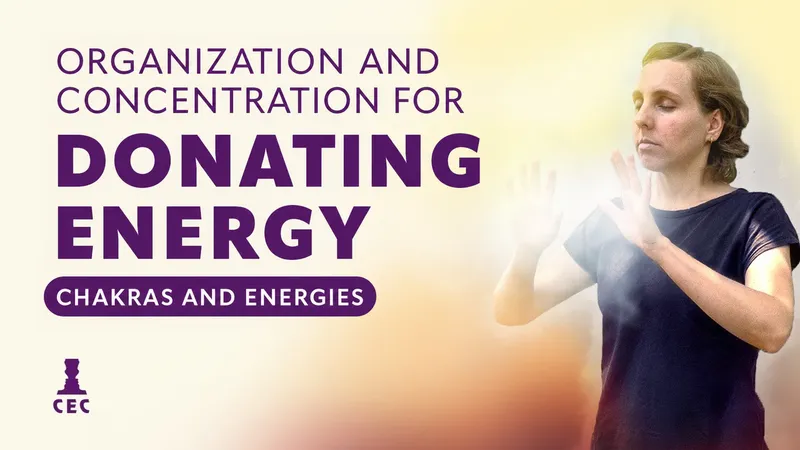
To donate energy, slow down before the scheduled time and minimize discomfort and interruptions. During the practice, focus your attention on the palms of your hands, even if you do not feel any energy, without dwelling on thoughts or getting irritated by distractions. Continuing the practice makes it easier to concentrate and benefits the donor by bringing consciousness to the heart chakra and elevating it. To begin, settle into a comfortable position without falling asleep: take three breaths while letting go of the charge that has built up, three while observing the air pressure, and three while noticing the temperature. Then rub your hands together, open and close them, and, with your eyes closed, exteriorize energy to the helpers at the Center for Consciousness Studies (CEC), with the best intentions.
Source transcript
Let us discuss some practices that can help make energy donation work calmer, more focused, and more attentive. This is the concern of CEC energy donors, and perhaps of all the other kinds of work. The central question is: how do I stay with the work I want to do so that it is effective? If the alarm goes off at donation time while you are doing something, it is very difficult to stop immediately, sit down, and begin donating energy. You may be at the computer, cooking, with your children, or talking with friends; it is difficult to shift from one activity to another without a pause. First, it is important to slow down before the donation time. If you know your donation is at 10:30 p.m., start slowing down. Each person has their own preparation time; if possible, see whether five or ten minutes beforehand is a good interval for you. Leave the previous activity, calm down, breathe, and circulate energy; any work will benefit you.
Another tip is to eliminate external discomforts that can take away your concentration. Are you going to do a ten-minute energy donation practice while hungry? You will probably think about the banana, almond, a nut, whatever you are going to eat, or pizza; your stomach will pull you toward the spleen chakra. Eliminate hunger, thirst, and discomforts such as cold or heat, adjusting the room temperature so that you feel as comfortable as possible in a good setting. Perhaps the main resource is to put the phone in airplane mode, because I doubt anyone can stay fully focused on exteriorization if WhatsApp starts beeping, the phone rings, or an Instagram notification arrives. Nobody will die if they leave the cell phone in airplane mode for ten minutes or cannot talk with us for ten minutes. If you do not want to put it in airplane mode, silence it or set it to "Do Not Disturb." An interesting idea is to have a sign saying "Do Not Disturb, I Am Practicing" on the bedroom door, so everyone knows this is your practice time. If you are making a big energy donation and your husband, dog, or child comes in to talk to you, you cannot stay focused: you have to answer or talk. It is ten minutes a day. Some people do more, but the proposal is to make at least one energy donation a day. Sometimes locking the door is not well accepted. The sign alerts the people and spirits around you that this is your moment and nothing will take away your concentration. If you cannot put up a sign because you are not in your own space or have trouble finding a corner at that moment, headphones can help block out external noise. You can put them on, turn on music, and seek that interiorization to do the work.
Some people ask: "Should I play music or not?" The use of music during the practice depends on each person. If music helps with concentration, it can be beneficial. The important thing is for the chosen elements to support focus on energy donation without diverting attention. The greatest challenge, however, is silencing the inner noise. Thoughts, conflicts, desires, and anguish can be more disturbing than any external distraction. They come from our desires, anguish, ambitions, or dreams. We are a big mix that is always at work; all these issues keep being worked through inside us even when we stop. A difficulty you had with someone during the day can make these thoughts come with full force. There is no airplane mode for this inner noise. One useful technique is to place ourselves as observers of our own thoughts without getting involved with them. Do not struggle with the reveries, difficulties, and conflicts you are producing; simply observe and let them pass. This is effective in meditation practices, but in the Daily Assistential Task, observing the thoughts that arise already takes attention away from the energy donation itself. In this work, focus should be redirected to energy donation without becoming upset or entering into conflict over producing many thoughts. Do not pay attention to what is happening so that it does not grow even more.
At first, it may be difficult, but the practice becomes easier over time. Even if the perception of energies is not clear, it is important to keep attention on the work. Sometimes a person who does not clearly perceive the energy or feel it coming out through the hands may ask: "What am I supposed to focus on if I do not feel anything?" As we feel it more and more, this becomes a little easier. Even if we do not feel anything right away, it is important to focus our attention on the palm of the hand, because that is where the work takes place. At least, that is where we are placing more of our intention. Perception arises through the hands when we place our consciousness there; if we do not place our consciousness there, we cannot develop that perception. With persistence, the difficulty decreases. If we lose concentration, we should not despair or become angry with ourselves; when we notice that our minds have wandered, we return to the focus. It is an exercise. This process is a continuous exercise, similar to mindfulness, in which we sit for three minutes daily and bring our focus back whenever the mind wanders. If three minutes is an exercise, ten minutes is a marathon. Over time, the mind wanders less. I think this takes effort and will. It is not easy to maintain focus for ten minutes, but the best resource is to try to perceive the palmar chakra and stay with it. For those who have great difficulty, it may help to begin with the heartbeat, keep some focus there, and then try to bring it to the palmar chakras.
There is no secret: our concentration reflects who we are. We will be fully present when we are a little more evolved and, as we say at CEC, have our consciousness in the upper part of the heart chakra. Until then, our path is to keep practicing without stopping and without anger. It is rewarding to see that, with practice, the initial difficulty decreases and we begin to feel pleasure. Someone might think: "Of course a person feels pleasure; would they do this work if it were not something happy, something good for them?" But the pleasure I mean is a feeling of stability; you may even begin to feel your heart chakra. When the alarm rings and this happens, you may think: "Wow, this feels so good that I do not want to stop." The desire is to continue. Now, when the alarm rings, you say: "All right, let me continue what I was doing." When you enter into attunement, you think: "Wow, I am fully connected." These gains come after some continuity.
Some people may feel this right away. For most of us, with conflicts and all these thoughts, the beginning is a little more difficult. Only with continuity can we attain the benefits. Above all, this work benefits us, because it is a great exercise in bringing ourselves to the heart chakra and raising our consciousness.
To begin the practice, as we did last week, we sit comfortably, noticing how our body feels and where we are. We can lie down, but we should take care not to relax too much. After a full day, this moment when we disconnect from everything can make us fall asleep; we need to pay attention to what we are about to do and not fall asleep. We feel where our legs and feet are supported, along with our buttocks and back, and notice how our chest feels and whether our shoulders are tense. We take three breaths, inhaling and exhaling, and let go fully with each exhale. As we let go, we feel all the energy and all the charge that may have built up in the body being exteriorized through the exhale.
We continue with a perception exercise that will bring us some focus by using the breath. We will inhale three times. First, I will explain: as we inhale, we place our attention on the pressure of the air. We feel the volume of air entering, the space it begins to occupy inside us, and the pressure it causes as it passes. We exhale and notice how we feel inside. Now, gently, we allow the air to enter, passing through the nasal passages, pharynx, larynx, and lungs; we notice the expansion it causes and the space it occupies. Notice how much you can expand your lungs without discomfort. Exhale in the same way, following the reverse path and feeling the decrease in pressure in the lungs. We repeat this two more times, paying attention to this factor. Now we do three more inhalations, changing the factor. Instead of pressure, we pay attention to temperature. We feel the temperature the air brings to our body as it passes through each part on its way to the lungs, following it through the expansion of the lungs. We notice the difference between our body's temperature and that of the air outside us. We take two more full breaths. We can open our eyes and return. Breathing centers and calms us, bringing us a little more into the present. We rub our hands: with the base of one hand, we rub the other fifteen times, leaving that hand relaxed; then we switch. We open and close our hands, trying to bend the fingers well back and applying a little force and intention to feel the muscles, tissues, and bones. We do this a few times. We close our eyes and begin the exteriorization of energies. We feel the palms of our hands and direct this energy, with the best intentions, toward the helpers of the Center for Consciousness Studies (CEC).
Questions raised by this material
- How do I prepare to donate energy?
- How do I avoid external distractions while donating energy?
- How do I deal with distracting thoughts while donating energy?
- How can I stay focused on donating without feeling the energies?
- How do I use breathing to focus before donating energy?
Keywords
How to cite
Murad, A., & Cabral, P. (2024, August 15). Organization and Concentration for Energy Donation [Video]. Center for Consciousness Studies. https://centrodeestudos.org/en/library/organization-and-concentration-for-energy-donation/