Give & Receive Energy

Summary
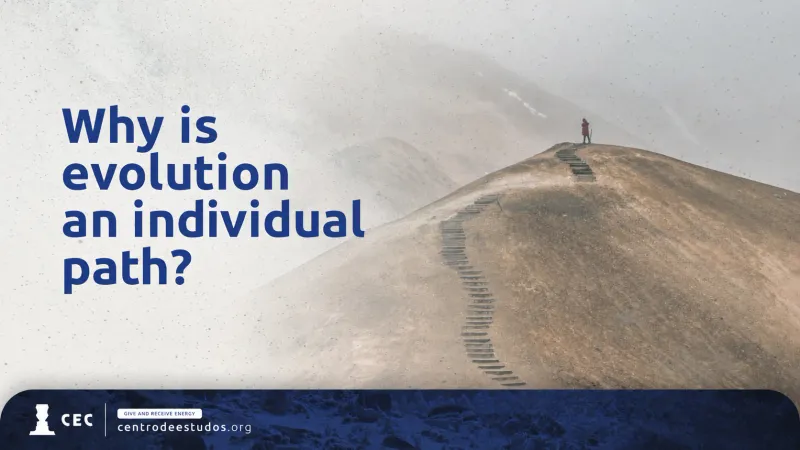
Evolution is individual because it depends on each person's effort, reflection, and choices. Relationships foster growth and also influence us through the energies we absorb, but no one can evolve for someone else. Improving oneself benefits the surrounding environment and does not require abandoning those who do not want to follow: we need to respect their choices and do what we can within the relationship. Knowing our own characteristics and overcoming dependence and reactions rooted in involvement help us individualize. Evolution is possible for everyone and has no final destination; each step forward, however small, brings happiness.
Source transcript
Evolution Is an Individual Path. The theme "evolution is an individual path" may not be clear to those encountering this content for the first time. For those who already follow this work, the central question is: how can this concept be applied in daily life? If evolution is an individual path, how does this manifest in relationships with things and people? And for those who still do not understand it well, what do they understand from this statement? The proposal is to promote a reflective exchange.
One participant commented that it is challenging to understand the concept that "everyone is one" while also thinking about individual evolution. Can evolving individually cause everyone to evolve as a consequence? Or have a negative impact, depending on our state? This reflection is not immediate. For those who already understand or believe they understand: how do they apply this in daily life? And for those who do not know it well: what do they understand when they hear that "evolution is an individual path"?
It is difficult for an extremely evolved person to cause everyone to evolve. We can affect some people, but causing everyone to evolve is almost impossible. A listener wrote that it is individual because each person has their own history. A listener said that it depends on ourselves and what we practice every day. A listener mentioned that it has to do with effort and energy. Evolution is individual, but it is clear how much one person affects another, positively or negatively. The strength of the group is significant. We grow through relationships, but evolution is individual. Our environment influences us, but what matters is what we do with that information.
Considering all the exchanges and groups into which we are born, our lives are made up of reference points. Parents, teachers, and professionals can affect us significantly. We are the result of collective production, but we are also individual beings. The collective affects us energetically. When we live with someone who is in a good condition, we absorb that energy. Our chakras produce energy according to our evolutionary level. Being immersed in groups with difficulties attunes us to that energy. The people with whom we interact affect us not only through words, but also through the energies we assimilate.
The central issue regarding the path being individual lies in the fact that everything we do and every result we achieve passes through an internal process: our own effort, elaboration, and objectives. We live on a planet of relationships and grow through them. Nevertheless, evolution is an individual path. There is a duality between the importance of relationships for growth and the need to develop as an individual. This can cause confusion because being with others is important, but being with oneself is essential. In theory, this may seem clear, but in practice it can be challenging.
Our society is structured around families, which generally share a similar evolutionary level. Moisés observes that everyone is born into families whose levels are close to their own. Conflict arises when we begin to see more, acquire knowledge, and want to advance. When we find something on the evolutionary path that benefits us, we feel the benefits quickly, even though evolution itself is slow. When we feel better, we want our family to share in this evolution. The first major conflict then arises: evolution is individual. We cannot evolve on behalf of the entire group. The question is how to help those who do not want to be helped, such as children or spouses who are not interested in spirituality.
This is the dilemma: moving forward or remaining with those who are stagnant. Individual evolution does not mean abandoning the group, but rather improving oneself and, consequently, the surrounding environment. Continuing relationships and learning from them are essential. Improving oneself inevitably improves the environment in which one lives. Individual evolution is not about leaving everything behind, but making a difference in one's own environment within the limits of what is possible. Every case is unique. The practice of individual evolution involves examining relationships and identifying forms of dependence. If there is dependence on another person, it can compromise the proposal of evolution.
The issue is not having difficulties, but not wanting to free oneself from them. Leaving someone behind occurs when we do not care about the other person. Caring for oneself while doing one's best within a relationship is not selfish. The other person may follow or not, according to their own choices. The people around someone committed to evolution may benefit. Even if only one person in the family is committed to growth, this can have a positive impact on the group. When someone follows a sincere spiritual path, helpers can facilitate situations, making the environment gentler so that the person can continue on their path.
Evolution is individual and must be carried out through one's own steps. Everyone must follow their own path. Being with someone who is highly committed brings enormous benefits, but it has no value if people do not take a step toward evolving individually. The theme is the individual path and effort, from which no one escapes. The more primitive our condition, the less we will feel the effect of someone advanced, even if they emanate subtle and beneficial energy.
If we are at the very beginning of the base chakra, we will be unable to benefit from or make use of these energies. If we are in a somewhat better condition, we can absorb more. To follow our individual path, it is important to know our characteristics. We cannot establish our individuality without understanding ourselves. As we resolve these characteristics, we also resolve involvement. As long as we lack clarity and a healthy relationship with others, we remain within the realm of involvement. In the family group, for example, when someone speaks badly of a relative, we feel that it has affected us. This reaction is primitive and culturally learned. We need to overcome these internal reactions and divisions in order to individualize ourselves and know our own energies.
For those who follow this work, it is difficult not to be committed to their own evolution. People become frustrated when they cannot help someone who does not want to be helped. The question is: how can I evolve alone when others do not want to follow? We should respect other people's choices, but by improving ourselves, we improve our surrounding environment. It is easier to live with someone who has better self-control or less anger or reactivity than with someone who has not even begun this path. We cannot evolve another person, but we can be a reference point and an example.
People observe us and may be inspired by our tranquility and behavior. We should dismantle the idea that simply asking with faith is enough to make something happen. Evolution is an individual path, and we should use examples to understand and follow our own path. Evolution is available to everyone, but it depends on our choices. In his book "Referential Continuity," Moisés discusses the origin of consciousness and its evolutionary path. We came here with the proposal of using our chakras and reaching the pinnacle, the crown chakra. Evolution is a possibility for everyone, but many are unaware that it exists.
We learn to earn money and get married, but not to evolve spiritually, which is what matters most. In the book "The Seven Date Seeds," Moisés tells of extraterrestrial consciousnesses on Earth. There were thirty, and they arrived on Earth thousands of years ago with the mission of contributing to human evolution, awakening one another when necessary. This shows how people around us can awaken us. We should value those who propel us upward, because these relationships are fundamental to our evolution. Evolution is individual, but relationships teach us patience and not to judge. We should recognize those who help us grow.
Evolution has no final destination. Every step we take is a source of happiness. There is no "where" to reach, but rather continuous growth. The very question "Where am I going to evolve to?" is already enlightening: we are limited, but we can become much greater. The experience of the path is the answer. Any advance, no matter how small, is already felt as happiness. We should continue and experience.
Questions raised by this material
- Why is spiritual evolution an individual path?
- How do relationships influence spiritual evolution?
- How can I evolve spiritually when my family is not interested?
- Why do you need to know yourself to evolve spiritually?
- Does spiritual evolution have an endpoint?
Keywords
How to cite
Murad, A., & Cabral, P. (2023, May 16). Why is evolution an individual path? [Video]. Center for Consciousness Studies. https://centrodeestudos.org/en/library/why-is-evolution-an-individual-path/