Give & Receive Energy

Summary
After physical death, we remain who we are, but we become more vulnerable without the physical body. That is why suicide does not solve our problems. A lack of spiritual knowledge can lead to denial of this continuity. During a lucid astral projection, Moisés encountered a man who had died by suicide and was unaware of his surroundings and did not respond to the exteriorization of energy. We cannot say that he was suffering, because suffering depends on each person's enlightenment and sensitivity. We should help without judging and make the most of physical life to better understand our actions and potential.
Source transcript
Today's topic is how the post-mortem unfolds for those who believe in nothing. This is a spiritualist perspective. Each of us asserts something based on our own knowledge, always believing that we may be right. However, given the immense universe, our human opinions may be wrong. What will be discussed here is the result of a path of study, but there are other people with different ideas who must also be considered and respected. The intention is not to say that the other person is wrong, but rather to present an idea for everyone to evaluate, with the sincere right to disagree, respecting other opinions.
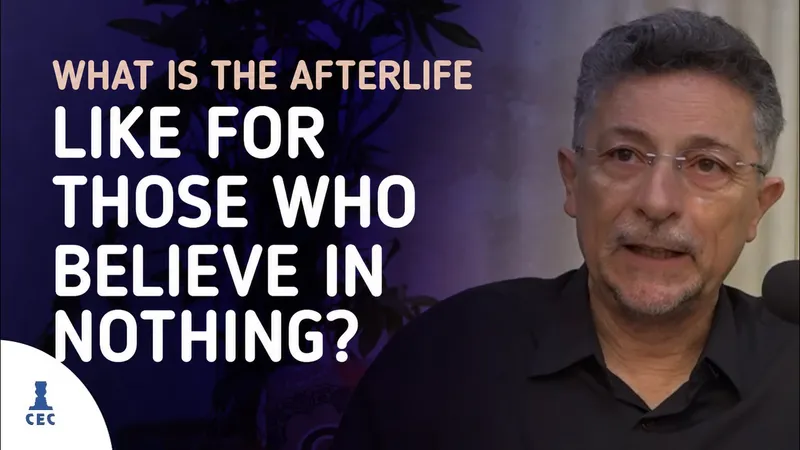
Regarding the post-mortem for those who believe in nothing, I believe that, after physical life, we go on being what we are in terms of consciousness, but with a little more suffering because we no longer have the physical body to defend ourselves. During life, we go through various experiences and learn from them. We cannot do what we have not learned. That learning does not bring us lucidity about the unknown. When we speak of death, we are referring to the other side of our path. Even while studying, we cannot become specialists even in physical life, let alone in the afterlife.
We live numbed by the information we consume. When we try to make decisions clearly, it is difficult, because what we have within us may not be enough for a true analysis. We spend life from birth until the surrender of the body. Let us suppose that someone lives 70 years. In 70 years, that person accumulates information, some of it from the last century, and witnesses a surge of inventions and technological improvements. That is the knowledge we acquire, but not necessarily a personal improvement in relation to our relationships.
On passing to the other side, we go on being what we were, but with difficulties. Without the physical body, it is like being without clothing, feeling unprotected. On the other side, without the physical body, we become vulnerable in a dimension where reality is different and more direct. Dealing with death without spiritual knowledge can lead to denial. Imagine waking up on the other side, seeing your family weeping at the wake. Accepting the loss of a history and of continuity is difficult. For those who believe in nothing, the post-mortem can be an intense denial, perhaps a total darkness, without acceptance of life after physical death.
A person dear to me had a brother who took his own life. He did not accept anything of spirituality; he denied life after physical death. For him, physical life was everything he could see and feel. Each person has their own space of knowledge and deals with it in their own way. When he could no longer bear physical life, he died by suicide. No one really understood why it had happened. This generally happens when someone can no longer bear certain things, whether emotional, financial, or relational, and thinks that ending life will solve the problems.
Believing that what we are continues is fundamental. It is not the case that everything changes when one ends physical life. We do not go to paradise, nor do we meet evolved consciousnesses. We go on being what we are. It is a harsh thought, but it makes sense. If it were that easy, everyone would take their own life to solve problems. The person who died by suicide goes on being what they were. When they asked me how he was, the people who asked believed in the existence of spirit and life after physical death. I even find it strange to speak of physical death, because death is something that is an end; I think it is more coherent to say that the person no longer has the physical body, that they changed vehicles. To verify this, I use my lucid astral projections, a practice I have pursued for 60 years.
During a projection, I encountered a person in a state of absolute denial. Spiritually, he looked like a zombie, without perception of the environment and unable to communicate. He was curled up, as if he had assumed a fetal position at the moment of death. I tried to exteriorize energy to revive him, seeking to establish some kind of communication. The idea was that, by talking, he might revitalize himself, realizing that there are other paths and that the situation is temporary. However, there was no movement in his energies, as if he were denying everything, refusing to accept any help or communication.
This experience illustrates how the post-mortem can be difficult for those who believe in nothing, resulting in a total denial. We cannot state that he was suffering, because suffering depends on the person's level of enlightenment and sensitivity. Someone with less knowledge may not feel the same suffering that a more enlightened person would feel in a similar situation. We must avoid judging the suffering of others and help in the best way possible. We must value life and make the most of this marvelous experience we have with the physical body. Unfortunately, we have not learned to do this properly. Often, we pass through life without noticing the details and the opportunities to better understand our actions and our potential.
Questions raised by this material
- What is the afterlife like for someone who does not believe in life after death?
- Why does suicide not resolve personal conflicts?
- How does denial hinder assistance after death?
- How does enlightenment influence suffering after death?
Keywords
How to cite
Esagüi, M. (2017, April 27). What Is the Afterlife Like For Someone Who Believes in Nothing? (Consciousness and Evolution Program) [Video]. Center for Consciousness Studies. https://centrodeestudos.org/en/library/what-is-the-afterlife-like-for-someone-who-believes-in-nothing-consciousness-and-evolution-program/